Theory and Design of Microwave Filters

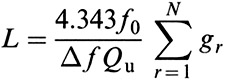
Among the most important specifications for microwave filters are selectivity, bandwidth, passband insertion loss and physical size. In fact as shown in Chapter 4 these are related for an all-pole bandpass filter by
| (8.1) | ![]() |
where f 0 is the centre frequency, ? f is the passband bandwidth, Q u is the unloaded Q of the resonators and g r is the element value of the rth element in the lowpass prototype. From this equation we can see that as we increase the selectivity of the filter then the number of elements, and hence the passband loss, increases. Furthermore, the roll-off of insertion loss across the passband also increases. Obviously we can use the optimum transfer function but the same relationship still holds. Also as we reduce the filter bandwidth we must increase the resonator Q if we are to maintain a fixed insertion loss. Now since Q u is proportional to volume for a microwave resonator, a highly selective, narrowband, low loss filter will require a significant physical volume. The question is, are there any ways in which we can overcome this problem?
Several alternative approaches will be discussed. These are dielectric resonators, high temperature superconductivity, surface acoustic wave devices, active filters and finally, the use of new subsystem architectures combined with predistorted reflection mode filters.
The loss of a dielectric resonator is largely determined by the dielectric loss tangent of the ceramic puck. This is...