Theory and Design of Microwave Filters

High performance waveguide filters with high Q cavities may take up a significant physical volume. This is disadvantageous in many telecommunications and space applications. One method of size reduction is to exploit the existence of multiple degenerate modes in waveguide cavities. This was first reported by Lin in 1951, for air cavities [10]. A complete theory for dual (two-mode) TE 11n mode waveguide bandpass filters was first reported by Atia and Williams in 1971 [11]. Since then further developments have been reported by Rhodes and Zabalawi [12] and Cameron and Rhodes [13]. Some of the most important results will be described in this section.
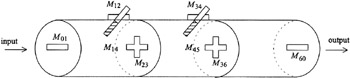
Consider the waveguide structure shown in Figure 6.38. In this structure each waveguide cavity supports two orthogonally polarised degenerate TE 111 mode resonances. Thus a 2nth-degree filter is realisable with n cavities, giving a significant size reduction. The modes in each cavity are coupled together by a tuning screw or other discontinuity which is oriented at 45 to the input iris. The two horizontally and vertically polarised modes in each cavity are coupled to the corresponding modes in adjacent cavities by a cruciform iris. The complete structure is known as a dual-mode in-line waveguide filter. For obvious reasons of isolation the input and output ports are at opposite ends of the structure.
The equivalent circuit of the sixth-degree filter is shown in Figure 6.39. In this diagram...