Theory and Design of Microwave Filters

The lumped lowpass prototype filters discussed so far are restricted to a 1 ? impedance level and a cut-off frequency of ? c = 1 rad/s. In reality we would like to design filters working into arbitrary impedance levels with arbitrary cut-off frequencies. We may require lowpass, highpass, bandpass or bandstop filters. Various circuit transformations to achieve this are described in the next section. Methods of realising impedance inverters and scaling internal circuit impedances to arbitrary levels are also described. In addition the effect of losses in real circuit elements and other practical issues are discussed.
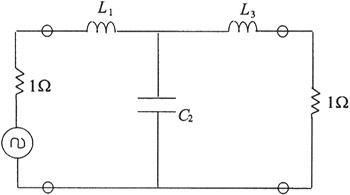
The lowpass prototypes normally have a system impedance of 1 ?, i.e. both the generator impedance Z G and load impedance Z L are 50 ? (Figure 4.1). Most, but not all, microwave filters operate in a 50 ? system. Historically 50 ? was chosen as a compromise between the losses and power handling capacity of coaxial cable. To convert from a 1 ? impedance level to an impedance level of Z 0 ? we simply scale the impedances of all the circuit elements in the filter by 50 ? (see Figure 4.2).
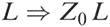
Thus for inductors
| (4.1) | |
That is,
| (4.2) | |
Thus the inductances are multiplied by Z 0.
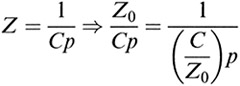
For the capacitors
| (4.3) | ![]() |
That is,
| (4.4) |