The Geometrical Tolerancing Desk Reference: Creating and Interpreting ISO Standard Technical Drawings


Engineering drawing practice (technical drawing) can be categorized into three sections:
General principles
This is concerned with technical drawing layout, scale, line types, text, sections, projection and how to show common features.
Dimensioning and size tolerancing
This is concerned with the principles of dimensioning and how to apply size tolerances (not geometrical tolerances) to technical drawings. It also covers machining requirements and surface texture.
Geometrical tolerancing
This is concerned with controlling FORM, LOCATION and ORIENTATION of a feature (axis, plane, surface, hole etc.). This is done by applying the principles of geometrical tolerancing to engineering drawings with the aid of geometrical symbols.
This book is concerned with Geometrical tolerancing only.
A geometrical tolerance is the maximum allowable variation of form or position of a feature. This is controlled by defining the size and shape of a tolerance zone. The specified part of the feature must be within this tolerance zone.
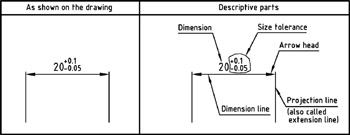
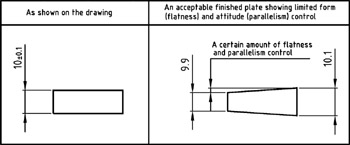
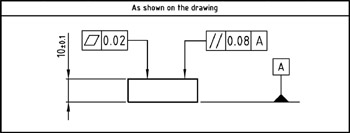
The size tolerance of a dimension (see figure 1.3) has a certain amount of control over form and attitude (see figure 1.4), but if a better degree of control is required then geometrical tolerances should be used (see figure 1.5).
Figure 1.3: Dimension
Figure 1.4: Limited form and attitude control
Figure 1.5: Example of geometrical tolerancing
Position of a feature is also controlled by geometrical tolerances.
The use of geometrical tolerances can increase manufacturing costs,...