Circuit Analysis II with MATLAB Applications

Designed for use in a second course in circuit analysis, this text engages a full spectrum of circuit analysis related subjects ranging from the most abstract to the most practical.
 TABLE OF CONTENTS
 This chapter begins with a discussion of elementary signals that may be applied to electric networks. The unit step, unit ramp, and delta functions are then introduced. The sampling and sifting properties of the delta function are defined and derived. Several examples for expressing a variety of waveforms in terms of these elementary signals are provided.
Consider the network of Figure 3.1 where the switch is closed at time t = 0.
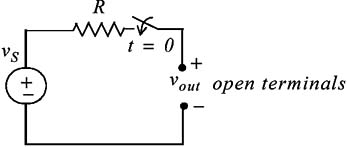
We wish to describe v out in a math form for the time interval ? ? < t < + ?. To do this, it is convenient to divide the time interval into two parts, ? ? < t < 0, and 0 < t < ?.
For the time interval ? ? < t < 0, the switch is open and therefore, the output voltage v out is zero. In other words,

For the time interval 0 < t < ?, the switch is closed. Then, the input voltage v S appears at the output, i.e.,

Combining (3.1) and (3.2) into a single relationship, we get

We can express (3.3) by the waveform shown in Figure 3.2.
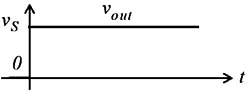
The waveform of Figure 3.2 is an example of a discontinuous function. A function...