Circuit Analysis II with MATLAB Applications

Designed for use in a second course in circuit analysis, this text engages a full spectrum of circuit analysis related subjects ranging from the most abstract to the most practical.
 TABLE OF CONTENTS
 This appendix discusses magnitude and frequency scaling procedures that allow us to transform circuits that contain passive devices with unrealistic values to equivalent circuits with realistic values.
Magnitude scaling is the process by which the impedance of a two terminal network is changed by a factor k m which is a real positive number greater or smaller than unity.
If we increase the input impedance by a factor k m, we must increase the impedance of each device of the network by the same factor. Thus, if a network consists of R, L, and C devices and we wish to scale this network by this factor, the magnitude scaling process entails the following transformations where the subscript m denotes magnitude scaling.
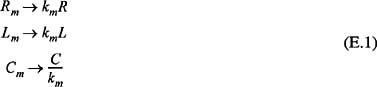
These transformations are consistent with the time-domain to frequency domain transformations
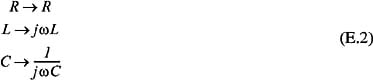
and the t-domain to s-domain transformations
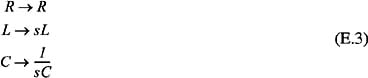
Frequency scaling is the process in which we change the values of the network devices so that at the new frequency the impedance of each device has the same value as at the original frequency. The frequency scaling factor is denoted as k f. This factor is also a real positive number and can be greater or smaller than unity.
The resistance value is independent of the frequency. However, the complex impedance of any inductor is sL, and in order to maintain the same impedance at a frequency k f times as great,...