Circuit Analysis II with MATLAB Applications

Designed for use in a second course in circuit analysis, this text engages a full spectrum of circuit analysis related subjects ranging from the most abstract to the most practical.
 TABLE OF CONTENTS
 This chapter is an introduction to three-phase power systems. The advantages of three-phase system operation are listed and computations of three phase systems are illustrated by several examples.
The circuits and networks we have discussed thus far are known as single-phase systems and can be either DC or AC. We recall that AC is preferable to DC because voltage levels can be changed by transformers. This allows more economical transmission and distribution. The flow of power in a three-phase system is constant rather than pulsating. Three-phase motors and generators start and run more smoothly since they have constant torque. They are also more economical.
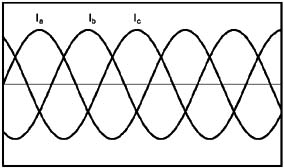
Figure 10.1 shows three single AC series circuits where, for simplicity, we have assumed that the internal impedance of the voltage sources have been combined with the load impedance. We also have assumed that the voltage sources are 120 out-of-phase, the load impedances are the same, and thus the currents I a, I b, and I c have the same magnitude but are 120 out-of-phase with each other as shown in Figure 10.2.

Let us use a single wire for the return current of all three circuits as shown below. This arrangement is known as four-wire, three-phase system.
This arrangement shown in Figure 10.3 uses only 4 wires instead of the