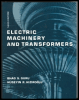
Electric Machinery and Transformers, Third Edition
Although the use of the International System of Units (SI) has become more and more prevalent in all areas of electrical engineering, English units are still widely used throughout the profession in dealing with electric machines. For example, it is easy to say that the speed of the motor is 1500 rpm (revolutions per minute) rather than saying 157 rad/s (radians per second). Similarly, a 0.25-hp (horsepower) motor is very rarely referred to as a 187-W (watt) motor. However, most equations in this book are given in SI units, and it sometimes becomes necessary to convert from one unit to another. In the International System of Units, the units of length, mass, and time are meter (m), kilogram (kg), and second (s), respectively. The basic unit of the charge is expressed in coulombs (C). The current is the time rate of change of charge and is expressed in amperes (A). Thus, 1 A = 1 C/s. Among other fundamental units are the unit of temperature, kelvins (K), and the luminous intensity, candelas (cd). In the English system of units, force is expressed in pounds, length in inches or feet, torque in foot-pounds, and time in seconds. The conversion from one unit to the other is given in Table A.1.
| From | Multiply by | To obtain |
|---|---|---|
| gilbert | 0.79577 | ampere turns (A-t) |
| ampere turns/cm | 2.54 | ampere turns/inch |
| ampere turns/in | 39.37 | ampere turns/meter |
| oersted | 79.577 | ampere turns/meter |
| lines (maxwells) | 10 ?8 | webers (Wb) |
| lines/cm 2 |