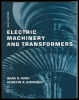
Electric Machinery and Transformers, Third Edition
The discussion of electric machines presented in the preceding chapters was limited to the steady-state operating conditions. That is, the machine has either been running at a given condition for a long time or adjusting from one operating condition to another very slowly so that the energy imbalance between the electrical and mechanical elements would be insignificant during the transition period. However, when the change from one operating condition to another is sudden, changes in the stored magnetic energy and the stored mechanical energy in terms of the inertia of the rotating members do not occur instantaneously. As a result, a finite time, known as the transient (dynamic) period, is needed to restore the energy balance from the initial to the final conditions. For example, if the applied voltage to a motor changes suddenly, the machine will undergo a transient period prior to attaining its new steady-state condition. In fact, such events occur quite often when machines are driven by electronic drives, as they generate periodic discontinuous voltage and current waveforms. 0 Another condition that may cause a change in the dynamic equilibrium of a machine is a sudden change in its load.
In Chapter 2 we pointed out that the magnetization characteristic of a magnetic material deviates from a straight line relationship at high values of magnetic flux density. It simply means that the permeability of a magnetic material is dependent upon the flux density in it. Only at low flux densities, where the magnetization characteristic follows...