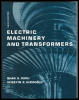
Electric Machinery and Transformers, Third Edition
Chapter 7: Synchronous Generators

7.1 Introduction

Alternating-current (ac) generators are commonly referred to as synchronous generators or alternators. A synchronous machine, whether it is a generator or a motor, operates at synchronous speed, that is, at the speed at which the magnetic field created by the field coils rotates. We have already elaborated this fact in Section 3.5 and obtained an expression for the synchronous speed N s in revolutions per minute (rpm) as

where f is the frequency in hertz (Hz) and P is the number of poles in the machine. Thus, for a 4-pole synchronous generator to generate power at 60 Hz, its speed of rotation must be 1800 rpm. On the other hand, a 4-pole synchronous motor operating from a 50-Hz source runs at only 1500 rpm. Any attempt to overload the synchronous motor may pull it out of synchronism and force it to stop.

During our discussion of a direct-current (dc) generator we realized that the electromotive force (emf) induced in its armature coils is of the alternating type. Therefore, we can convert a dc generator to an ac generator by (a) replacing its commutator with a set of slip rings and (b) rotating the armature at a constant (synchronous) speed. The idea is novel but is not put into practice for the reasons we will mention shortly.

We also recall that the relative motion of a conductor with respect to the magnetic flux in a machine is responsible for the induced emf in...

UNLIMITED FREE
ACCESS
TO THE WORLD'S BEST IDEAS

SUBMIT
Already a GlobalSpec user? Log in.

This is embarrasing...

An error occurred while processing the form. Please try again in a few minutes.

Customize Your GlobalSpec Experience

Category: Motor Coils
Finish!
Privacy Policy

This is embarrasing...

An error occurred while processing the form. Please try again in a few minutes.