Electric Machinery and Transformers, Third Edition

4.2: Construction of a Transformer

4.2 Construction of a Transformer

In order to keep the core loss to a minimum, the core of a transformer is built up of thin laminations of highly permeable ferromagnetic material such as silicon-sheet steel. Silicon steel is used because of its nonaging properties and low magnetic losses. The lamination's thickness varies from 0.014 inch to 0.024 inch. A thin coating of varnish is applied to both sides of the lamination in order to provide high interlamination resistance. The process of cutting the laminations to the proper size results in punching and shearing strains. These strains cause an increase in the core loss. In order to remove the punching and shearing strains, the laminations are subjected to high temperatures in a controlled environment for some time. It is known as the annealing process.

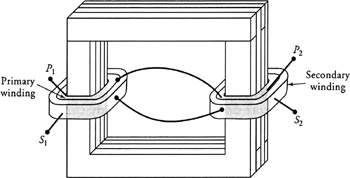
Basically two types of construction are in common use for the transformers: shell type and core type. In the construction of a shell-type transformer, the two windings are usually wound over the same leg of the magnetic core, as shown in Figure 4.1. In a core-type transformer, shown in Figure 4.2, each winding may be evenly split and wound on both legs of the rectangular core. The nomenclature, shell type and core type, is derived from the fact that in a shell-type transformer the core encircles the windings, whereas the windings envelop the core in a core-type transformer.


Figure 4.1: Shell-type transformer.

Figure 4.2: Core-type transformer.

For relatively low power applications with moderate voltage...

UNLIMITED FREE
ACCESS
TO THE WORLD'S BEST IDEAS

SUBMIT
Already a GlobalSpec user? Log in.

This is embarrasing...

An error occurred while processing the form. Please try again in a few minutes.

Customize Your GlobalSpec Experience

Category: Single Phase Transformers
Finish!
Privacy Policy

This is embarrasing...

An error occurred while processing the form. Please try again in a few minutes.