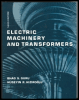
Electric Machinery and Transformers, Third Edition
We all know that energy exists in many forms, and we use numerous devices on a daily basis that convert one form of energy into another. When we speak of electromechanical energy conversion, however, we mean either the conversion of electric energy into mechanical energy or vice versa. For example, an electric motor converts electric energy into mechanical energy. On the other hand, an electric generator transforms mechanical energy to electric energy. In this chapter, our aim is to explore the basic principles of electromechanical energy conversion.
Electromechanical energy conversion is a reversible process except for the losses in the system. The term "reversible" implies that the energy can be transferred back and forth between the electrical and the mechanical systems. However, each time we go through an energy conversion process, some of the energy is converted into heat and is lost from the system forever.
When a current-carrying conductor is placed in a magnetic field, it experiences a force that tends to move it. If the conductor is free to move in the direction of the magnetic force, the magnetic field aids in the conversion of electric energy into mechanical energy. This is essentially the principle of operation of all electric motors. On the other hand, if an externally applied force makes the conductor move in a direction opposite to the magnetic force, the mechanical energy is converted into electric energy. Generator action is based upon this principle. In both cases, the magnetic field acts as a...