Integrated Circuit Design for High-Speed Frequency Synthesis

8.7: Injection-Locked Oscillators

8.7 Injection-Locked Oscillators

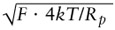
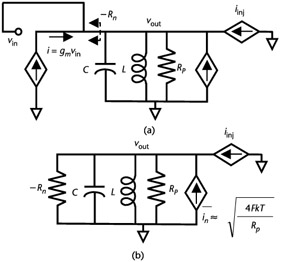
If, rather than noise, a signal is injected into an oscillator, and if that signal is large enough, then it will pull the oscillator to that frequency. This phenomenon is known as injection locking. To study the effect of an injected signal, consider the model shown in Figure 8.16(a), where the oscillator feedback is shown on the left, and the injected noise and injected signal are shown on the right. The feedback transconductance g m can be seen as providing a negative resistance - R n equal to -1/ G m, as shown in Figure 8.16(b). The injected noise current has an expected value of , where F, the equivalent noise factor of the oscillator, indicates how much additional noise is added by active circuitry. In addition, it is noted that any input resistance of the transconductance stage has been absorbed in R p.


Figure 8.16: Feedback model of oscillator with noise input (this will be used to demonstrate injection locking) (a) with feedback through g m, and (b) with - R n.

Under large-signal conditions, the negative and positive resistances in parallel nearly cancel out, resulting in a nearly ideal resonant circuit such that the noise input is amplified to produce the large-signal oscillator output voltage v out. Since there is a finite input power, the gain cannot be infinite. However, since the gain is very large, R n will be approximately equal to R p

UNLIMITED FREE
ACCESS
TO THE WORLD'S BEST IDEAS

SUBMIT
Already a GlobalSpec user? Log in.

This is embarrasing...

An error occurred while processing the form. Please try again in a few minutes.

Customize Your GlobalSpec Experience

Category: Operational Transconductance Amplifiers (OTA)
Finish!
Privacy Policy

This is embarrasing...

An error occurred while processing the form. Please try again in a few minutes.