Integrated Circuit Design for High-Speed Frequency Synthesis

8.3: LC-Based VCOs

8.3 LC-Based VCOs

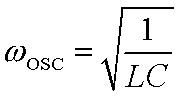
The LC resonator at the core of LC oscillators determines the frequency of oscillation and often forms part of the feedback mechanism used to obtain sustained oscillations. The frequency of oscillation will be given approximately by

(8.1)

Any oscillation, once started, will tend to decay due to the losses in the resonator. In order to maintain sustained oscillations, it is necessary to provide feedback to restore energy. Two popular ways to achieve this are by the Colpitts oscillator or the negative G m oscillator. These can be shown with bipolar or MOS transistors; here we show the MOS versions. Note that with MOS, one can choose NMOS or PMOS. NMOS will have higher g m for the same transistor size and current; however, PMOS will have lower 1/ f noise. Differential versions of these two oscillators are shown in Figure 8.2. Note that the trend is for CMOS oscillators to be nearly exclusively of the negative G m variety because of their simplicity. However, Colpitts oscillators are not completely extinct, especially with bipolar transistors, so some knowledge of them can be valuable.


Figure 8.2: Basic differential oscillators (a) Colpitts common gate, (b) Colpitts common drain, (c) - G m oscillator (NMOS only), (d) - G m oscillator (PMOS only), and (e) - G m oscillator (complementary).

8.3.1 Inductors

Of all the passive structures used in RF circuits, high-quality inductors are traditionally among the most difficult to realize monolithically. In silicon,...

UNLIMITED FREE
ACCESS
TO THE WORLD'S BEST IDEAS

SUBMIT
Already a GlobalSpec user? Log in.

This is embarrasing...

An error occurred while processing the form. Please try again in a few minutes.

Customize Your GlobalSpec Experience

Category: Oscillators
Finish!
Privacy Policy

This is embarrasing...

An error occurred while processing the form. Please try again in a few minutes.