Integrated Circuit Design for High-Speed Frequency Synthesis

8.4: Oscillator Analysis

8.4 Oscillator Analysis

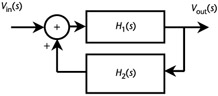
Mathematically, if a system has poles on the j ? axis of the s plane, it forms an oscillator. That is, in the transfer function, with s replaced by j ?, if there is some ? for which the denominator of the transfer function goes to zero, the system will oscillate at this frequency. In filtering terms, if the poles approach the j ? axis from the left-hand side of the s plane, the Q of the system is very high and approaches infinity. Thus, in a resonator, one can think of a negative resistance canceling the positive resistive losses to cause the Q to go to infinity, forming an oscillator. Alternatively, one can think of a feedback system, where the feedback causes the characteristic equation (the denominator of the transfer function) to go to zero for some value of s = j ?. All of these ways of looking at oscillators are equivalent. Let us now look in more detail at the feedback method to analyze oscillators. Consider the feedback system shown in Figure 8.12.


Figure 8.12: Feedback model of an oscillator.

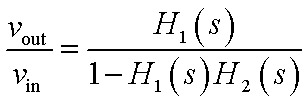
The transfer function can be written as

(8.3)

Here, the product of H 1( s) and H 2( s) can be seen to be the open-loop gain, often simply called the loop gain. If the open-loop gain goes to one, the transfer function goes to infinity. In the neighborhood of...

UNLIMITED FREE
ACCESS
TO THE WORLD'S BEST IDEAS

SUBMIT
Already a GlobalSpec user? Log in.

This is embarrasing...

An error occurred while processing the form. Please try again in a few minutes.

Customize Your GlobalSpec Experience

Category: IC Electronic Filters
Finish!
Privacy Policy

This is embarrasing...

An error occurred while processing the form. Please try again in a few minutes.