Integrated Circuit Design for High-Speed Frequency Synthesis

Chapter 7: Charge Pumps and Loop Filters

7.1 Introduction

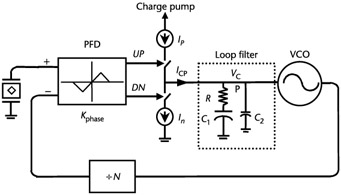
A charge pump is the first analog component of a synthesizer that will be considered. It is responsible for placing charge into or taking charge out of the loop filter, and, therefore, moving the control voltage on the VCO up or down, as shown in Figure 7.1. Charge pumps must be very carefully designed to minimize reference feedthrough or phase noise. In spite of numerous variations, a charge pump will usually be composed of two current sources and two switches. This chapter also deals with loop filters. Although Chapter 3 has already considered basic loop filters, a large number of modifications to improve performance can be added to the basic design.


Figure 7.1: A system-level diagram of a basic synthesizer.

7.2 Charge Pumps

The following sections will deal with various charge pump design issues, and circuit-level designs will be presented.

7.2.1 A Basic Charge Pump

Probably one of the most basic and common charge pumps is shown in Figure 7.2. This charge pump consists of four transistors M 1 through M 4. Transistors M 1 and M 4 act as current sources, while transistors M 2 and M 3 act like switches that are controlled by the PFD. When the PFD is in the tristate, then UP must be high (at V DD), while DN must be connected low (to V SS). Note that an inverter between the PFD output and the DN or UP input of the charge pump...

UNLIMITED FREE
ACCESS
TO THE WORLD'S BEST IDEAS

SUBMIT
Already a GlobalSpec user? Log in.

This is embarrasing...

An error occurred while processing the form. Please try again in a few minutes.

Customize Your GlobalSpec Experience

Category: Charge Pump Regulators
Finish!
Privacy Policy

This is embarrasing...

An error occurred while processing the form. Please try again in a few minutes.