Integrated Circuit Design for High-Speed Frequency Synthesis

Chapter 11: Direct Modulation in Frequency Synthesizers

11.1 Introduction

This chapter introduces techniques to produce digital modulation using synthesizers. There are many types of modulation (ways of encoding data onto a carrier for transmission) in use today. In some applications, the data rate is low; therefore, a simple modulation scheme is adequate and preferred as it reduces the requirements on the radio. Modulation is required in transmission because it is not feasible to build an antenna that will transmit baseband. Instead, the information is first modulated around a carrier. Usually the bandwidth that the data occupies is a small fraction of the frequency at which it is transmitted.

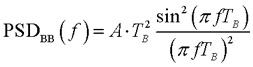
In digital communications, a transmitted sequence of bits represents the information. In the simplest case, at low data rates, one bit at a time may be transmitted. In general, the data stream is random; therefore, it has power over a range of frequencies. By comparison, a pure square wave has power at one frequency and at odd harmonics of that frequency. The PSD of an NRZ data stream of bit rate T B at baseband can be approximated as

(11.1)

where A is a constant of proportionality. Equation (11.1) is plotted in Figure 11.1. Note that most of the power in the signal is concentrated in frequencies below the bit frequency f B = 1/ T B. Thus, it is often acceptable to limit the spectrum of the transmitted information to 1.4 times f B and still have the system function...

UNLIMITED FREE
ACCESS
TO THE WORLD'S BEST IDEAS

SUBMIT
Already a GlobalSpec user? Log in.

This is embarrasing...

An error occurred while processing the form. Please try again in a few minutes.

Customize Your GlobalSpec Experience

Category: RF Receivers
Finish!
Privacy Policy

This is embarrasing...

An error occurred while processing the form. Please try again in a few minutes.