Reliability & Life Testing Handbook, Volume 1

The exponential distribution is a very commonly used distribution in reliability and life testing, because it represents the times-to-failure distribution of components, equipment and systems exhibiting a constant failure rate characteristic with operating time. This chapter is an abbreviated version of Chapter 5 in [1], where extensive and detailed coverage of the exponential distribution is presented. The reader desiring more details should study Chapter 5 of [1]. Failures which result in a constant failure rate characteristic are called chance failures. Consequently, the times-to-failure distribution of chance failures is the exponential.
The single-parameter exponential pdf is
| (6.1) | |
where
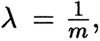
| ? | = | constant failure rate, in failures per unit of measurement period, e.g., failures per hour, per million hours, per million cycles, per million miles, per million actuations, per million rounds, etc., |
| ? | = | |
| m | = | mean time between failures, or mean time to a failure, |
| e | = | 2.718281828, |
and
| T | = | operating time, life, or age, in hours, cycles, miles, actuations, rounds, etc. |
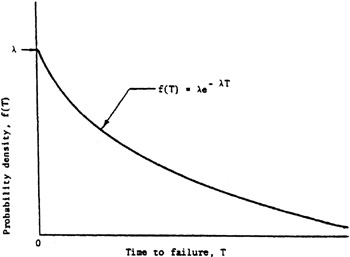
This distribution requires the knowledge of only one parameter, ?, for its application. Figure 6.1 illustrates Eq. (6.1).
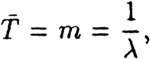
The mean, T, is
| (6.2) | |
the median,
, is
| (6.3) | |
the mode,
, is
| (6.4) | |
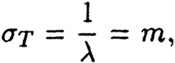
the standard deviation, ? T, is
| (6.5) | |
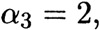
the coefficient of skewness, ? 3, is
| (6.6) | |
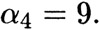
and the coefficient of kurtosis, ? 4, is
| (6.7) | |
The two-parameter exponential pdf is
| (6.8) | |
where ? is the location...