Reliability & Life Testing Handbook, Volume 1

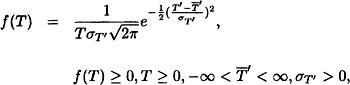
The two-parameter lognormal distribution, illustrated in Figs. 11.1 (a) and (b), is given by [1]
| (11.1) | |
| (11.2) | |
where
| T' | = | mean of the Naperian, or natural, logarithms of the times to failure, log e hr, |
and
| ? T' | = | standard deviation of the Naperian, or natural, logarithms of the times to failure, log e hr. |
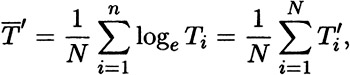
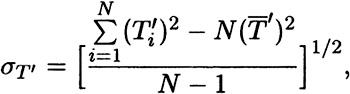
A random variable is lognormally distributed if the logarithm of the random variable is normally distributed. It is for this reason that Eq. (11.1) has its two parameters, T' and ? T', in terms of the logarithms of the data values. These parameters are determined as follows:
| (11.3) | |
and
| (11.4) | |
where N is the total number of measurements made, or of the time-to-failure data obtained. Furthermore, to find reliabilities, areas under the pdf have to be determined by integration. But the lognormal pdf is not exactly and directly integrable, whereas the areas under the standardized normal pdf have been tabulated. As a lognormal pdf can be transformed to a normal pdf through the transform log e T = T', and the parameters of this transformed, and now normal pdf, are T'' and ? T', it is computationally more convenient to write the lognormal pdf in terms of T' and ? T', which have to be found anyway to calculate reliabilities with lognormal times-to-failure distributions.
Since the logarithms of a...