Reliability & Life Testing Handbook, Volume 1

If there is an abundance of time-to-failure data; e.g., 35 or more, and preferably 100 or more, then a quick, simple and easy data analysis procedure would be the following:
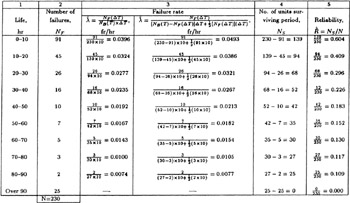
Group the data by prechosen life intervals, such as 10-hr intervals, as in Table 4.1. When grouping make sure that values of times to failure up to but not equal to the end value of each interval are counted in that interval. Values equal to the end value and up to the end of the next interval but not including the end value of this interval, are counted as belonging to this next interval.
|
![]() |
Count how many of the failures have occurred in each interval, like 91 failures in the first 10 hr of operation in Table 4.1, 45 failures during the second 10 hr of operation, etc., until all units are accounted for, or 230 units. In this case the test was stopped after the first 205 units failed; therefore, we do not know when the remaining 25 units will fail had the test been continued until all 230 units failed. Consequently, we do not know the ? T to enable the calculation of the failure rate. As eventually all units will fail N s ? 0 and R ? 0.
With the information in Columns 1 and 2 of Table 4.1 construct a number of failures histogram,