Reliability & Life Testing Handbook, Volume 1

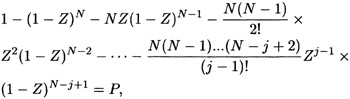
When the ranks and the sample size needed are not in available tables, the general formula for computing the rank Z for the jth failure, or the mean order number, of a sample of size N with a desired probability P is [1; 2, p. 51]
| (14.1) | |
where Z is a value between zero and unity, and j = 1, 2,..., N.
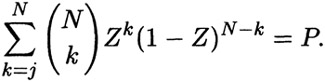
Equation (14.1) can be rearranged as
| (14.2) | |
It is apparent that Eq. (14.2) is the cumulative binomial distribution function, and it may be solved for Z by iterative computer methods given N, j and P. This is a tedious process, however. An easier method is to apply two transformations to Eq. (14.2), first to the beta distribution equivalent of the binomial and second to the F distribution equivalent of the beta distribution, and obtain [3, p.498; 4, p. 398]
| (14.3) | |
and
| (14.4) | |
where
| LR ? | = | lower rank value in decimals for the rank of ? in decimals; e.g., for the 5% rank, LR ? is the LR 0.05 value for the rank of ? = 0.05, |
| N | = | sample size tested, |
| j | = | mean rank order number or failure order number, |
| F l-?; 2( N-j +1);2 j | = | F distribution value such that the area under the F distribution with m = 2( N - j + 1) and n = 2 j |