VLSI ReferencePoint Suite

The VLSI ReferencePoint Suite is an exclusive, growing series of high-impact, in-depth articles inspired by our users.
The Very Large Scale Integrated (VLSI) design is used to create complex circuits to integrate millions of electronic components, such as resistors, capacitators, and logic gates, on a chip. Most modern chips use the VLSI architecture because of its relatively simple design techniques.
This ReferencePoint describes the characteristics of a good design and introduces VLSI techniques. It also explains the Metal Oxide Semiconductor (MOS) transistor theory and the Complementary Metal Oxide Semiconductor (CMOS) processing technology.
To design a digital electronic circuit, first sketch its system, subsystem, and logic design. The layout must be accurate and unambiguous. Next, create a model of the circuit and perform a yield analysis to verify the design rules and identify its parameters. The yield analysis and design rules are used to verify:
Device design
Integration of the design process
Characterization of the design process
Figure 1-1-1 shows the hierarchy in the design of an electronic circuit:
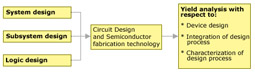
After the design of the system, the subsystem, and the logic is laid out and confirmed, an electronic interconnection circuit is constructed. A yield analysis is performed after the circuit design is complete.
To develop a digital electronic circuit:
Create rough sketches of the design.
Visualize additional functionality.
Design the hierarchy of control.
Identify perspectives of the design.
The first important task when developing an entire digital electronic circuit is to make rough sketches of the design. To...

 TABLE OF CONTENTS