
Bridge Rectifier Electronic Bridges
Last Updated: April 1, 2025
Description
A bridge rectifier is an electronic device that converts alternating current (AC) to direct current (DC). It consists of four diodes arranged in a bridge configuration, allowing it to rectify both halves of the AC waveform, resulting in a full-wave rectification. This setup provides a more consistent DC output compared to half-wave rectifiers.
Working Principle
The bridge rectifier operates by utilizing four diodes to create two paths for the AC input at each terminal. During the positive half-cycle of the AC input, two diodes conduct, allowing current to flow through the load in one direction. During the negative half-cycle, the other two diodes conduct, maintaining the same direction of current flow through the load. This results in a constant polarity across the DC output, making the bridge rectifier useful for applications requiring a stable DC supply from an AC source.
Applications
Bridge rectifiers are commonly used in power supplies for electronic devices, where they convert AC from the mains into DC for the device's operation. Specific examples include their use in battery chargers, DC motor drives, and power supplies for televisions and radios.
Advantages over other Electronic Bridges
Compared to half-wave rectifiers, bridge rectifiers provide 141% more current and are more efficient, as they utilize both halves of the AC waveform. This results in a more stable DC output, which is crucial for applications requiring a consistent power supply.
Limitations
One limitation of bridge rectifiers is their cost, which is higher than that of half-wave rectifiers due to the additional diodes required. Additionally, the output voltage is not referenced to just line or neutral, making certain control methods, such as triac control, impossible.
Considerations
When considering the use of a bridge rectifier, factors such as initial costs, operating expenses, and maintenance should be evaluated. The initial cost is higher due to the need for four diodes, but the increased efficiency can offset operating expenses over time. Durability and accuracy are generally high, but regular maintenance may be required to ensure optimal performance and longevity. Replacement costs should also be considered, especially in high-power applications where component stress is significant.
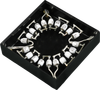
from Voltage Multipliers, Inc.
VMI ’s single phase bridges are assembled with VMI diodes, then encapsulated in a rigid epoxy. VMI manufactures high voltage assemblies ranging from 5kV to 20kV, 70nS to 3000nS, 50mA to 2.2A. [See More]
- Product Type: Bridge Rectifier
- Mounting Style: PCB

from Semikron, Inc.
Bridge Rectifier Modules for reliable inverter design. Bridge rectifiers are components which have every branch of a rectifier circuit in a single, compact case. Bridge rectifiers exist from a few amps to several hundred amps in different package types. SEMIKRON offers bridge rectifier modules in... [See More]
- Product Type: Bridge Rectifier