
Monitor / Controller Soldering Irons, Stations, and Accessories
Last Updated: April 1, 2025
Description
Monitor/controller soldering irons, stations, and accessories are advanced tools used in the soldering process to ensure precise temperature control and efficient heat management. These devices are equipped with microprocessor-controlled systems that allow for real-time monitoring and adjustment of the soldering temperature, ensuring consistent performance and reducing the risk of damage to sensitive electronic components.
Working Principle
The working principle of monitor/controller soldering irons involves heat conduction and the electrothermal effect. These devices consist of a heating element, a thermocouple, and a temperature control device. When the soldering iron is powered, the heating element generates high temperatures. The thermocouple senses this temperature and sends the data to the temperature control device, which adjusts the power supply to maintain a stable operating temperature. This precise temperature control is crucial for achieving high-quality solder joints and preventing overheating of components .
Applications
Monitor/controller soldering irons are widely used in the electronics industry for tasks that require precision and reliability. Specific applications include touch-up, repair, and replacement on printed circuit boards, as well as point-to-point wiring and installation in mainframes or chassis .
Advantages over other Soldering Irons, Stations, and Accessories
One of the main advantages of monitor/controller soldering irons is their ability to maintain a stable temperature, which is essential for delicate soldering tasks. This feature reduces the risk of thermal damage to components and ensures consistent soldering quality. Additionally, the microprocessor-controlled systems provide real-time feedback and adjustments, enhancing the efficiency and accuracy of the soldering process .
Limitations
Despite their advantages, monitor/controller soldering irons can have limitations, such as higher initial costs compared to basic soldering irons. They may also require more maintenance due to their complex electronic components, and their advanced features might not be necessary for simpler soldering tasks.
Considerations
When selecting monitor/controller soldering irons, several factors should be considered. Initial costs can be higher due to the advanced technology involved. Operating expenses may also increase if regular maintenance and calibration are required to ensure accuracy and durability. However, the benefits of precise temperature control and reduced risk of component damage can outweigh these costs, especially in professional settings where high-quality soldering is critical.

from AMADA Weld Tech
Miyachi Unitek's high-throughput Uni-Turn Plus heat sealing system fulfills even the most demanding manufacturing requirements. The motorized rotary table can be set for 2 to 6 positions, each of which may be equipped with bonding heads, fluxing stations, automatic ACF laminating stations and... [See More]
- Equipment Type: Complete System; Soldering Station or Power Source; Weld Monitor or Controller
- AC Input Voltage: 115/120V_60Hz (optional feature); International Power or Voltages - 50 Hz
- Process Capability: Reflow
- Input Current: ? to 16

from AMADA Weld Tech
Miyachi Unitek's Desktop Bonders are table top hot-bar systems which utilize pulsed heat thermode technology for reflow-soldering and heat seal bonding. With a quick and inexpensive tooling and thermode retrofit, Miyachi Unitek's Desktop Bonders can also do heat staking at a fraction of the price of... [See More]
- Equipment Type: Complete System; Soldering Station or Power Source; Weld Monitor or Controller
- Technology: Pulsed Heat Thermode
- Process Capability: Reflow
- Features: Adjustable Frame

from AMADA Weld Tech
Designed for repair and low volume production applications, the Emerald Series flat panel display repair stations can handle a range of different panel sizes using a variety of pulsed or constant heat bonding methods. One system can manage displays from 3" to 80" wide. The systems are designed for... [See More]
- Equipment Type: Complete System; Soldering Station or Power Source; Weld Monitor or Controller
- AC Input Voltage: 115/120V_60Hz; 208-230/240V_60Hz; International Power or Voltages - 50 Hz
- Process Capability: Reflow
- Input Current: ? to 16

from AMADA Weld Tech
Uni-Slide Plus is a stand-alone pulsed-heat hot-bar system designed for manufacturing environments where force levels, product positions, and process settings need to be changed often. Uni-Slide Plus employs a motorized linear slide for product movement as well as a motorized bonding head. Uniflow2... [See More]
- Equipment Type: Complete System; Soldering Station or Power Source; Weld Monitor or Controller
- AC Input Voltage: 115/120V_60Hz (optional feature); 208-230/240V_60Hz; International Power or Voltages - 50 Hz
- Process Capability: Reflow
- Input Current: ? to 16
from AMADA Weld Tech
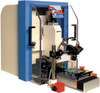
The Uni-Slide bonding system is designed for use in high mix/low volume production or R &D environments. Product is manually loaded, aligned and unloaded in the front position of the slide, and processed in the rear position. Uni-slide produces reliable and consistent results according to the... [See More]
- Equipment Type: Complete System; Soldering Station or Power Source; Weld Monitor or Controller
- AC Input Voltage: 115/120V_60Hz (optional feature); 208-230/240V_60Hz; International Power or Voltages - 50 Hz
- Process Capability: Reflow
- Input Current: ? to 16

from AMADA Weld Tech
The Uni-Turn stand-alone bonding system is designed for use in high mix/low volume production or R &D environments. Product is loaded on one side of the two-position rotary table, while being processed on the other. The stand-alone systems are suitable for Hot Bar Reflow Soldering and... [See More]
- Equipment Type: Complete System; Soldering Station or Power Source; Weld Monitor or Controller
- AC Input Voltage: 208-230/240V_60Hz; International Power or Voltages - 50 Hz
- Process Capability: Reflow
- Input Current: ? to 16

from AMADA Weld Tech
The stand-alone Uni-Base hot bar reflow soldering system is the first in a line of (semi-) automatic systems developed for Hot Bar Reflow Soldering, Heat-Sealing and ACF-bonding. Flexible enough for R &D environments or volume manufacturing where automation is not necessary. Typical product... [See More]
- Equipment Type: Complete System; Soldering Station or Power Source; Weld Monitor or Controller
- AC Input Voltage: 115/120V_60Hz (optional feature); 208-230/240V_60Hz; International Power or Voltages - 50 Hz
- Process Capability: Reflow
- Input Current: ? to 16