
Utilities Safety Gloves
Last Updated: April 1, 2025
Description
Utilities safety gloves are designed to prevent electrical shock and protect against arc flash and arc blast. These gloves are voltage-rated and may offer some abrasion resistance, ensuring the safety of individuals working in environments where electrical hazards are present .
Working Principle
Utilities safety gloves work by providing a barrier between the wearer and electrical currents. They are made from materials that are electrically nonconductive, which helps to prevent the flow of electricity through the gloves and into the wearer's body. This is crucial in reducing the risk of electrical shock. The gloves are also designed to dissipate heat, which is important in protecting against arc flash and arc blast incidents .
Applications
Utilities safety gloves are essential in environments where there is a risk of electrical exposure. Specific examples include working on live electrical panels, handling high-voltage equipment, and performing maintenance on electrical systems in industrial settings. These gloves are a critical component of personal protective equipment (PPE) for electricians and other professionals who work with or near electrical systems .
Advantages over other Safety Gloves
Utilities safety gloves offer specific advantages over general-purpose gloves, particularly in their ability to prevent electrical shock. While general-purpose gloves may provide heat protection, they do not offer the same level of protection against electrical hazards. Utilities safety gloves are specifically designed to maintain their dielectric properties, making them more effective in environments where electrical safety is a concern .
Limitations
One of the limitations of utilities safety gloves is that they can be cumbersome or bulky, which may make it difficult for workers to perform tasks that require dexterity. This can lead to situations where workers might choose not to wear them, increasing the risk of injury. Additionally, these gloves are considered the least effective safety method under the NFPA 70E hierarchy of controls due to the potential for human error in their use .
Considerations
When selecting utilities safety gloves, it is important to consider factors such as initial costs, operating expenses, durability, and maintenance. The gloves must be regularly tested and maintained to ensure they retain their dielectric properties. Replacement costs should also be considered, as gloves that are damaged or worn out must be replaced to maintain safety standards. Proper training on the use and care of these gloves is essential to maximize their effectiveness and longevity .

from Westek Electronics, Inc.
Westek Short Fingered Leather Gloves [See More]
- Industry: Building & Construction; Utilities
- Material: Leather
- Application: Abrasion Resistant
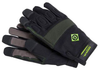
from Greenlee Textron, Inc.
HANDYMAN TYPE. LYCRA (PANEL) MATERIAL. L SIZE. BLACK COLOR. 13 INCH OVERALL LENGTH. WORK AND OUTDOOR ACTIVITY APPLICATION. WOVEN ELASTIC CUFF TYPE. CUFF SIZE 1-1/2 INCH [See More]
- Industry: Utilities
- Material: Lycra (Panel)
- Application: Abrasion Resistant

from Greenlee Textron, Inc.
TRADESMAN TYPE. NEOPRENE (CUFF), TERRY CLOTH (THUMB) MATERIAL. L SIZE. 14 INCH OVERALL LENGTH. JOB SITE APPLICATION [See More]
- Industry: Utilities
- Material: Neoprene; Neoprene (Cuff), Terry Cloth (Thumb)
- Application: Abrasion Resistant