
Products & Services
See also: Categories | Featured Products | Technical Articles | More Information-
Supplier: igus® inc.
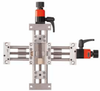
Description: For manual adjustments Flat and compact High torsional stability (stiffening) All construction materials: VA and V4A stainless steel 100 % self-lubricating Resistant to chemicals and corrosion Available accessories
- Stroke or X-Axis Travel: 7.87402 inch
- Y-Axis Travel: 300 inch
- Axis Configuration: X-Y Axes
-
Supplier: Schneeberger Inc.
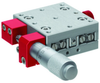
Description: tables consist of square top and bottom parts. This enables easy assembly as a 2-axis table. The table parts are made of aluminum. Type NH can be set up horizontally and vertically.
- Stroke or X-Axis Travel: 0.5118113 to 1.574804 inch
- Carriage Load: 95.54 to 319.216 lbs
- Base Length: 1.574804 to 4.330711 inch
- Base Width: 1.574804 to 4.330711 inch
-
Supplier: igus® inc.
Description: Special Properties: Low cost cross slide solution for manual adjustments Self-lubricating and corrosion resistant Maximum stroke length in XY tables 300 mm (installation sizes 1040/1080) Maximum stroke length in XY tables 150 mm (installation sizes 0630) Optionally
- Stroke or X-Axis Travel: 11.81103 inch
- Y-Axis Travel: 11.81103 inch
- Orientation: Horizontal
- Drive Type: Lead Screw/ACME Screw
-
-
Supplier: LaserStar Technologies Corporation
Description: Motion Device X / Y Table 9” X 6” Motion Device X / Y Table 15” X 9” Programmable Motorized XY Stage Stage Travel 322: X=6”, Y=4” Stage Travel 323: X=12”, Y=7” Maximum Weight: 322 = 5 lbs., 323 = 5 lbs. Base Mounting Platform with Manual Z Axis Adjustment Two Axis Control
- Stroke or X-Axis Travel: 6 to 12 inch
- Y-Axis Travel: 4 to 7 inch
- Axis Configuration: X-Y Axes
-
Supplier: LaserStar Technologies Corporation
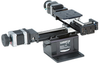
Description: X/Y Theta Table 9" x 6" Programmable Motorized Three (3) Axis Motion System X=6", Y=4" Stage Set with Oriental NEMA 17 Stepper Motors Motorized Rotary Stage, Three Jaw Chuck and Mounting Plate Manual Adjustment KNobs on XY and Rotary Two Axis Control Bos with Built-in Driver
- Stroke or X-Axis Travel: 6 inch
- Y-Axis Travel: 4 inch
- Features: Rotary Axis
- Motor Type: Stepper
-
Supplier: Newport MKS
Description: be easily adapted to fit a specific system's needs. In the shown image, the MT-RS rotation mount is mounted to our MT-X manual stage using one side of the adapter bracket. Optical Table Mounting MT Stages can be mounted to optical tables using the table clamp. Optical
- Stroke or X-Axis Travel: 0.37401595 inch
- Device Type: Dovetail Slide
- Axis Configuration: X-Y Axes
-
Supplier: Newport MKS
Description: easily adapted to fit a specific system's needs. In the shown image, the MT-RS rotation mount is mounted to our MT-X manual stage using one side of the adapter bracket. Optical Table Mounting MT Stages can be mounted to optical tables using the table clamp. Optical Rail
- Stroke or X-Axis Travel: 0.37401595 inch
- Device Type: Dovetail Slide
- Axis Configuration: X-Y Axes
-
Supplier: Newport MKS
Description: The DS65-XY Compact Dovetail Linear Stage is preferred for small 1.0 inch XY travel applications where set, lock, and forget is required. It is much less susceptible to shock and vibration than bearing stages. The DS series incorporates precision preloaded dovetail slides with an 80
- Stroke or X-Axis Travel: 1.00000054 inch
- Device Type: Dovetail Slide
- Axis Configuration: X-Y Axes
-
Supplier: Newport MKS
Description: The DS40-XY Compact Dovetail Linear Stage is preferred for small 0.55 inch XY travel applications where set, lock, and forget is required. It is much less susceptible to shock and vibration than bearing stages. The DS series incorporates precision preloaded dovetail slides with an 80
- Stroke or X-Axis Travel: 0.5511814 inch
- Device Type: Dovetail Slide
- Axis Configuration: X-Y Axes
-
Supplier: LaserStar Technologies Corporation
Description: X / Y Table 15” X 9” Laser Engraving Systems Programmable Motorized XY Stage Stage Travel 322: X=6”, Y=4” Stage Travel 323: X=12”, Y=7” Maximum Weight: 322 = 5 lbs., 323 = 5 lbs. Base Mounting Platform with Manual or Motorized Z Axis Adjustment Two Axis Control Box with Built-in
- Stroke or X-Axis Travel: 6 to 12 inch
- Y-Axis Travel: 4 to 7 inch
- Axis Configuration: X-Y Axes, X-Y-Z Axes
-
Supplier: LaserStar Technologies Corporation
Description: X / Y Table 15” X 9” Laser Engraving Systems Programmable Motorized XY Stage Stage Travel 322: X=6”, Y=4” Stage Travel 323: X=12”, Y=7” Maximum Weight: 322 = 5 lbs., 323 = 5 lbs. Base Mounting Platform with Manual or Motorized Z Axis Adjustment Two Axis Control Box with Built-in
- Stroke or X-Axis Travel: 6 to 12 inch
- Y-Axis Travel: 4 to 7 inch
- Axis Configuration: X-Y Axes, X-Y-Z Axes
-
Supplier: PI (Physik Instrumente) L.P.
Description: directions (tip and tilt). The tabletop surface is made from durable, wear- resistant stainless-steel. This accessory is ideal for metrology, roundness measurement, and part gauging applications. Table Diameters from 75mm to 300mm Manual Operation 4 Axes of Motion (X, Y, Tip, Tilt)
- Stroke or X-Axis Travel: 0.1181103 inch
- Bearing Type: Air Bearing
- Motor Type: None
- Axis Configuration: Tip/Tilt Axes, X-Y Axes
-
Supplier: Fischer Technology, Inc.
Description: distance (up to 80 mm) Automated serial testing with programmable XY-table and Z-axis (optional) Ideal for the measurement of very thin layers using the silicon drift detector with high energy resolution (XDAL device) Applications: Coating Thickness Measurement Measurement of coatings
- Mounting / Loading Options: Benchtop / Floor
- Features: Coating Thickness, X-ray / Gamma
- Attribute Measurement Capability: Thickness Gage
-
Supplier: Mad City Labs, Inc.
Description: assemblies. Standard Manual MicroStages are offered for the following inverted microscopes: Olympus IX/IX2 Series, Nikon TE2000/Ti Series, Leica DMI Series, and Zeiss Axiovert/Axio Observer Series. Manual MicroStages designed to fit other setups, including direct mounting to optical
- Maximum X-Distance: 25 mm
- Maximum Y-Distance: 25 mm
- Minimum Step Size (Resolution): 10 µm
- Stage Type: Motorized Stage
-
Supplier: CSA Group
Description: laser beam welding machine using 2D moving optics or an X-Y table, the type 2 test is applicable. ISO 22827-2:2005 is not applicable for welding cells with manual positioning of the welding head and/or the component, and for fixed-position welding without the moving mechanism.
-
Description: laser beam welding machine using 2D moving optics or an X-Y table, the type 2 test is applicable. ISO 22827-2:2005 is not applicable for welding cells with manual positioning of the welding head and/or the component, and for fixed-position welding without the moving mechanism.
-
Description: (i.e. high temperatures) and dust-tight IP64 laser head Shortest setup with Autofocus in the M-Series workstations (3 times faster vs. manual focus finding) and due to intelligent software features (Parameter Matrix Tool, contour offset, mark alignment, etc.)
- Cutting / Traverse Speed: 47,244.0944881889 in/min
- Laser Output Power: 20 watts
- Marking Area Length: 12.0866207 inch
- Marking Area Width: 12.0866207 inch
-
Supplier: Trotec Laser, Inc.
Description: The SP Series CO2 laser cutters are the comprehensive solution for cutting large-format materials. Equipped with a 49" x 28" working area, pass-through capabilities, and CO2 power options ranging from 60W to 200W, the SP500 is one of the most versatile laser cutters on the market.
- Cutting / Traverse Speed: 5,999.999999999987 in/min
- X-axis Travel / Length Capacity: 49.0157745 inch
- Y-axis Travel / Width Capacity: 27.952771 inch
- Laser Output Power: 60.00000000000001 to 200 watts
-
Supplier: Mad City Labs, Inc.
Description: aided manual operation. MadAFM™ can accomodate samples up to 50mm x 50mm x 40mm in size. MadAFM™ supports multiple microscopy modes (see specification table) and includes AFMView®-OD software that handles all hardware control and data acquisition. The user-friendly software features
- Features: AFM, Mechanical Stage
- Grade: Benchtop
- Application: Biological / Life Science
- Remote Interface: Computer Interface, Image Analysis Processing Software
-
Supplier: PlasmaCAM, Inc.
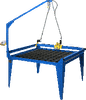
Description: edges in long parts. Wide plasma cutting torch compatibility with a simple, easy-to-install interface. Works with common hand torch (machine torch not needed). Includes specialized PlasmaCAM design and control software. Video-based instruction manual is easy to navigate and guides you with





Find Suppliers by Category Top
Featured Products Top
-

-
include single-axis, XY, and multi-axis systems. Each table is delivered as a complete motion subsystem with air bearing guideways, platen, linear motor or ball-screw drive, encoder interface, and air supply conditioning. Performance Specifications - Positioning (read more)
Browse Wafer Chucks Datasheets for Fountyl Technologies Pte. Ltd. -
Linear motion bearings are bearings that are made to move in a particular direction, and they come in a wide array of different designs. Some linear slides are motorized, others are not. Examples of the former include roller and XY tables as well as machine and (read more)
Browse Linear Slides and Linear Stages Datasheets for NB Corporation of America -
motion bearings are bearings that are made to move in a particular direction, and they come in a wide array of different designs. Some linear slides are motorized, others are not. Examples of the former include roller and XY tables as well as machine and dovetail slides. Non-motorized slides include (read more)
Browse Linear Bearings Datasheets for NB Corporation of America -
– Seaming, gluing, cut-to-length systems Backstop Gauging – Extrusion machinery, cut-to-length systems X-Y Positioning – Cutting tables, gluing equipment (read more)
Browse Rotary Encoders Datasheets for Encoder Products Company -
Timing – Pick-and-place robots, rotary tables for filling, bottle labeling X-Y Positioning – Pick-and-place robots (read more)
Browse Absolute Rotary Encoders Datasheets for Encoder Products Company -
available in various sizes with travels ranging from 0.25" to 2.0". They support X, XY, and XYZ configurations, accommodating loads from 4 lbs on our miniature ball slide series up to 160 lbs on our crossed roller positioning stages, with straight-line positioning accuracy of 0.0001" per inch of travel (read more)
Browse Linear Slides and Linear Stages Datasheets for Isotech, Inc. -
throughout post-processing, enabling users to restrict the displayed frequency range when plotting or tabulating results. Relevant data can be isolated, reducing clutter in dense broadband graphs and result tables. Additional Updates The (read more)
Browse Finite-difference time-domain (FDTD) Software Datasheets for Remcom (USA)
Conduct Research Top
-
XY Tables: How Do They Differ from Cartesian and Gantry Systems?
was designed for. In many industrial applications, Cartesian and gantry-style robots are prevalent, but in precision applications, XY tables are often the better choice, due to their compact, rigid structure and very high travel and positioning accuracy.
-
Case Studies [Positioning Switch] : Detected Deviation of the X-Y Axes of a Machining Table
Metrol's IP67 waterproof "Precision Positioning Switch" can demonstrate 0.5 repeatability even under harsh environment in machine tools where coolant and cutting chips splatter.
-
What is Racking in Gantry Systems, And How Can it be Avoided?
Gantries differ from other types of multi-axis systems (such as Cartesian robots and XY tables) by using two base (X) axes in parallel, with a perpendicular (Y) axis connecting them. While this dual X-axis arrangement provides a wide, stable footprint and allows gantry systems to deliver high load
-
What is Racking in Gantry Systems?
Gantries differ from other types of multi-axis systems (such as Cartesian robots and XY tables) by using two base (X) axes in parallel, with a perpendicular (Y) axis connecting them. While this dual X-axis arrangement provides a wide, stable footprint and allows gantry systems to deliver high load
-
Part 1 - What is Racking in Gantry Systems, and How Can it be Avoided?
Gantries differ from other types of multi-axis systems (such as Cartesian robots and XY tables) by using two base (X) axes in parallel, with a perpendicular (Y) axis connecting them. While this dual X-axis arrangement provides a wide, stable footprint and allows gantry systems to deliver high load
-
What Makes A Linear Stage Different From Other Types Of Linear Motion Systems?
and operating principles. Case in point: The term "actuator" typically refers to a linear motion system with an aluminum housing that encloses the guide and drive mechanisms; systems referred to as "tables," or "XY tables," are commonly designed with a flat baseplate to which the guide and drive components
-
Guide to Linear Motion Systems
and XY tables as well as machine and dovetail slides. Non-motorized slides include dovetail, roller and ball bearing varieties, which allow for movement with a minimum of friction, whether the slide is powered manually or through resistance. Regardless of the bearing type â€" ball, dovetail, fluid
-
What is a Split Bridge System and How Does it Differ from a Gantry?
Multi-axis linear systems come in a variety of designs, with Cartesian, gantry, and XY tables being some of the most common types. While these designs simplify construction and can provide space savings, they also introduce "stacking " errors -- the compounding of errors from each axis, which
More Information Top
 Indicates content that may require registration and/or purchase.

-
Optimised 3D surface measurement of hydroxyapatite layers using adapted white light scanning interferometry
The piezo-table was mounted on precision stainless steel manual XY tables .
-
Inspection and measurement of a DWDM core with two stacked glass objects
PC controlled XY Table Manual Stage .
-
Drop-by-drop deposition of ceramic slurry for fabrication of PZT microstructures
Attempts to build walls assisted by a manual xy - table .
-
Process chain precision forges
Is also a manually mounts on xy - table to operate on the axis of rotation to be able to carry out the following component position correction in two degrees of freedom.
-
Products and method
The microscope platform with own Dampfungbeinhaltetneben the stand with manually to betatigendern XY table a CCD color camera with lens system and monitor to the optical Probenbeobachtungsowie a lighting device fur Auflicht and Durchlicht.
-
Advances in Mass Data Analysis of Signals and Images in Medicine, Biotechnology and Chemistry
It controls the manual or automated shift of the xy - table between the image- acquisition position under the lens and the loading position, where the object slide is shifted from the object-slide preparation unit to the xy-table.
-
Measurement of Large Forces and Deflections in Microstructures
The above equipment is mounted on a fixture that is attached to a manual xy -actuator (a small xy- table ).
-
MEMS testing and applications in automotive and aerospace industries
The above equipment is mounted on a fixture that is attached to a manual xy -actuator (a small xy- table ).