
Autotransformers Information
Last revised: October 23, 2024
Reviewed by: Scott Orlosky, consulting engineer
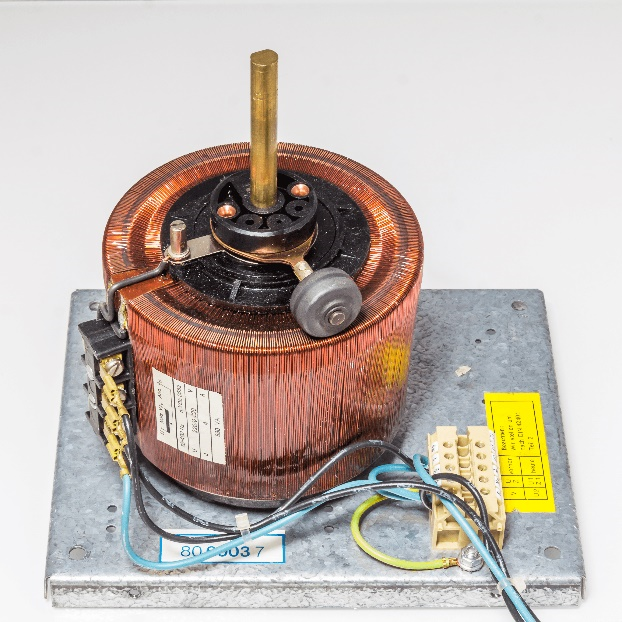 Autotransformers are a special type of power transformer with only one winding. A portion of this single coil serves as a part of both the primary and secondary winding. Different voltages are obtained by tapping or connecting at different points along the winding, which has at least three taps where electrical connections are made. Both the voltage source and the electrical load are connected to two taps. The tap at the end of the winding serves as a common connection to both circuits. Typically, autotransformers are used in low-power applications and to interconnect systems operating at different voltage classes. They may be waterproof, rated for outdoor use, or equipped with NEMA enclosures.
Specifications
Product specifications for autotransformers include:
- operating frequency range
- maximum primary voltage rating
- maximum secondary voltage rating
- maximum secondary current rating
- power rating
- operating temperature
Types
There are three basic types of products: single phase, three phase (polyphase), and variable.
- Single phase autotransformers, as their name suggests, operate with single phase voltage.
- Three phase autotransformers are polyphase devices in which the three primary windings are connected together and the three secondary windings are connected together.
- Variable autotransformers, or variacs, have a sliding tap.
Core type and cooling method are important specifications to consider when selecting autotransformers. There are three main choices for core type: laminated, split, and toroidal. Autotransformers with other unlisted or proprietary core types are also available. Choices for cooling method include air cooled, oil filled, and water cooled. Dry-type or air cooled power transformers do not have a core. Instead, the transformer enclosure or housing is ventilated to allow air flow. Oil-filled autotransformers immerse the winding and core in oil to keep the device cool. The oil is also used as an insulator.
Features
Autotransformers differ in terms of winding turns and output voltage. With step-up transformers, the secondary voltage is larger than the primary voltage. With step-down devices, the secondary voltage is smaller than the primary voltage. Variacs, or variable autotransformers (autoformers), have a setting for changing the turn ratio as needed. One-to-one devices have a turn ratio of 1:1, or near 1:1. There are two choices for output voltage type: alternating current (AC) and direct current (DC). Typically, the AC waveform output voltage values for autotransformers are expressed as root mean square (RMS) values.
Autotransformers FAQs
What are the advantages and disadvantages of using an autotransformer?
Autotransformers are generally cheaper in initial cost compared to conventional two-winding transformers of similar ratings. They can deliver more power and are more efficient for the same physical dimensions and power rating.
The main disadvantage is the loss of electrical isolation between the high- and low-voltage sides, which can be a critical factor in certain applications.
What are some common applications of autotransformers?
Autotransformers are typically used in low power applications to connect circuits with different voltage classes. They are smaller, lighter, and cheaper than other transformers and are often used where electrical isolation is not a requirement.
What is a variac or variable autotransformer?
A variac, or variable autotransformer, is a type of autotransformer with an adjustable tap that allows for changing the turn ratio as needed. This provides adjustable output voltage, often used for smooth voltage control.
What are the differences between autotransformers and two-winding transformers?
Winding Configuration
Autotransformers: They have a single continuous winding that serves both the primary and secondary functions. This winding is tapped at different points to provide the desired voltage levels. The primary and secondary are electrically interconnected, allowing energy transfer by both conduction and induction.
Two-Winding Transformers: These have two separate windings, primary and secondary, which are electrically isolated from each other. Energy transfer occurs solely through magnetic induction.
Electrical Isolation
Autotransformers: Do not provide electrical isolation between the input and output circuits due to the shared winding.
Two-Winding Transformers: Provide electrical isolation between the primary and secondary circuits, which is crucial for safety in certain applications.
Cost and Efficiency
Autotransformers: Generally cheaper and more efficient than two-winding transformers of similar ratings. They can deliver more power for the same physical dimensions.
Two-Winding Transformers: Typically more expensive due to the need for separate windings and provide less efficiency compared to autotransformers of the same rating.
Applications
Autotransformers: Commonly used in applications where electrical isolation is not required, such as voltage regulation and connecting circuits with different voltage classes
Two-Winding Transformers: Used in applications where electrical isolation is necessary, such as in power distribution and safety-critical systems.
These differences highlight the distinct roles each type of transformer plays in electrical systems, with autotransformers being more suitable for cost-effective and efficient applications without isolation requirements, while two-winding transformers are preferred for applications needing electrical separation.
What is the concept of electrical isolation in transformers?
Electrical isolation in transformers refers to the separation of electrical circuits to prevent direct electrical connection between them. This is achieved by using two distinct windings, the primary and the secondary, which are magnetically coupled but electrically isolated from each other.
Isolation transformers are used in applications where electrical separation is necessary, such as in power distribution systems, medical equipment, and safety-critical systems. They ensure that the output circuit is protected from any electrical issues occurring in the input circuit.
What are the safety benefits of using isolation transformers?
Safety benefits are a direct result of their design. There is no direct electrical path between the input and output circuits, ensuring that there is electrical isolation between primary and secondary coils.
By isolating the input and output circuits, isolation transformers prevent the transfer of electrical faults or surges from one circuit to another. This is crucial for protecting sensitive equipment and ensuring the safety of the system.
Electrical isolation also helps in reducing noise and interference between circuits. This is particularly important in sensitive electronic applications where signal integrity is critical.
Isolation transformers are used in applications where electrical separation is necessary, such as in power distribution systems, medical equipment, and safety-critical systems. They ensure that the output circuit is protected from any electrical issues occurring in the input circuit.
What are the differences between single-phase and three-phase transformers?
Phase Configuration
Single-Phase Transformers: These transformers operate on a single-phase AC system, meaning they rely on a voltage cycle that operates in a unified time phase. They are often used for power distribution and voltage reduction in residential and light-commercial applications.
Three-Phase Transformers: These are designed for use in three-phase AC systems, which are common in industrial and high-power applications. They contain six total coils (three primary and three secondary) to accommodate all three signals.
Construction
Single-Phase Transformers: Typically have two windings (primary and secondary) on a magnetic core. They can be either core type or shell type, with the core type carrying half the number of turns on each coil and the shell type carrying the complete winding on one central coil.
Three-Phase Transformers: Can be constructed using three single-phase transformers or as a single unit with all six windings on a common magnetic core. They can be connected in various configurations such as wye (Y) or delta (Δ).
Applications
Single-Phase Transformers: More popular in non-urban areas due to lower electrical demand and cost considerations. They are used for residential and commercial power distribution.
Three-Phase Transformers: Used in industrial and high-power applications where the power grid is designed as a three-phase system. They are essential for efficient power transmission over long distances.
Cost and Efficiency
Single-Phase Transformers: Generally more cost-effective for lower power applications and are suitable for areas with lower electrical demand.
Three-Phase Transformers: More efficient for high-power applications and are preferred in industrial settings due to their ability to handle larger loads and provide balanced power distribution.
Autotransformers Media Gallery
References
GlobalSpec—Single-Phase Transformers Information
GlobalSpec—Electric Machinery and Transformers, Third Edition
GlobalSpec—Power Transmission
GlobalSpec—Single-Phrase Transformers
Image credit:
Raimond Spekking / CC BY-SA 4.0