I could not have generated the information, collected the photographs, or completed the project without the assistance and aid of others. I want to thank all of those who contributed to the successful completion of this book. My first debt is, of course, to my three amazing children who encouraged me to discover my writing purpose and pursue it with intense passion and perseverance. I am grateful that they understood the world must know this story. I am deeply grateful to my friend Mohsin Ali, former diplomatic editor for Reuters, who helped tremendously by serving as a guest lecturer to my college classes while I attended the many meetings. The hundreds of college students who participated in the research and surveys helped to get this book written. Unfortunately, some of these students perished in motor vehicle crashes. Many others were involved in crashes that caused them pain and injury. It was common to hear tragic stories on a daily basis. I constantly thank my college students and remind them that their involvement was important. What is written is never forgotten. I tell them that we learn more from our mistakes than from our successes. Hopefully, in this second century of motor vehicle travel, these students can experience the freedom to travel safely. I received much support and advice, and sometimes the best advice came from the naysayers who told me I was wasting my time. Fortunately, I turned all their negatives into positives. Many individuals are mentioned within, but this book is solely my project and all of the opinions expressed here (except for the direct quotations) are my own. I do not speak or write for the automakers, government safety establishment, standards development organizations, or advocates—but I do include their own works in my book and also what others have commented about them. I do not bash any group for all are important and I am very careful to be factual. I express my grateful appreciation to those who gave permission to use news articles and extended quotations such as the National Academies of Sciences / Transportation Research Board (TRB), the New York Times, Automotive News and EE Times, the World Health Organization (WHO) and the World Bank. Robert Kern, my literary agent in Chapel Hill, North Carolina and Cathy Faduska, my senior editor at IEEE Press / John Wiley & Sons, Inc. and Kay Ethier of Bright Path Solutions, Durham, North Carolina, helped craft the initial structure of my manuscript and greatly improved the book. The entire point of an editor is to decide what is and what is not fit to print, and any book will have some selection criteria. Those criteria and the editor's judgment are its bias. The best that any author can do is make it as clear as possible why everything should be included so as to avoid "unbiased" reporting where no one can be portrayed as being wrong or opposing safety. No courage is required to publish a sanitized, non-critical version of events. To do otherwise requires a higher standard. Vehicle and highway safety cannot be accomplished through the efforts of one person, a group, or a government agency. It is a shared responsibility among people who travel, the companies that provide transport, and the agencies that regulate travel. But, one person can make a difference toward the goal of safe travel. Someday, when we are "actually all safer" while traveling in crash-proof vehicles on intelligent highways, I want to tell my children's children that I knew about this problem and did my best to erase it when I could. I will tell them in life we have two choices, try or do nothing. To me it was impossible to witness the terrible pain and suffering and not get involved. Road safety is no accident. Silence is the ultimate weapon of power in vehicle and highway safety. This book will break that silence. |
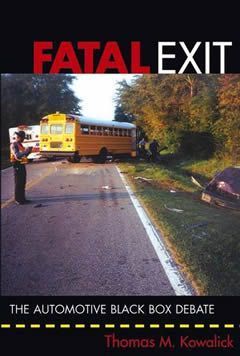 One of the great pleasures of finishing a book is that it gives the author the opportunity to thank those who helped make the project a product.
 TABLE OF CONTENTS
 Fatal Exit - Introduction
In the midst of a late-night lightning storm some years ago, the unmistakable screech of tires and shattered glass woke me from my sleep. As I sat up in bed, sweating and shaking and unaware of my surroundings, I slowly regained my bearings and realized that what roused me was not anything in the waking world, but my own horrific dream. It was merely a dream, but the nightmare was rooted in the reality of my past, of car crashes that have shaped my life and altered my future. And in this, I know I am not alone. The odds are good that you are with me. Perhaps you've been in a car crash, or witnessed one, or suddenly lost someone dear to you on one of the world's roadways or highways. In all likelihood, you know someone whose life was turned upside down by a car crash. Maybe it was a friend of a friend, or the classmate of a daughter, or a former neighbor's child. If so, the illusion of automobile and highway safety has had a profound impact on you. The truth is, though, that there is not a person alive in the civilized world who does not have a stake in the game of vehicle and highway safety. Statistically speaking, automobile crashes are the nation's largest public health hazard with over 3 million highway motor vehicle deaths in the United States since 1899. According to the National Highway Traffic Safety Administration (NHTSA), there were 6,327,252 crashes involving more than 24 million people in the United States in 2003. The victims suffered 2,889,000 injuries, and we mourned the loss of 42,643 men, women and children in those crashes. 193.3 million people drive, so for those of us behind the wheel, the stakes are obvious. But even if you do not drive a vehicle, you surely ride in one. Your loved ones drive. You walk on the sides of roadways where cars and buses and trucks zip along at speeds that could take your life without a moment's notice. It is impossible not to be somehow impacted by the operation of 230,199,000 registered vehicles in our nation, all of which are potentially lethal weapons. Perhaps you have never taken the time to ponder why it is that, as yet, there is no real solution to one of the most troublesome problems in contemporary civilization: motor vehicle injury and death. When you take the time to think about it, an obvious question is: why isn't someone doing something about all this? Of course, much is being done on many other issues besides MVEDRs. Or, another question might be: is there anything that CAN be done? Now if you knew that the data currently culled from the scenes of automobile crashes were virtually useless, merely serve to create tragic statistics, and provide little information of practical, life-saving value. If you knew that simple, cost-effective technology existed that could record precisely what happens in car crashes so that the experts could work to create the conditions that would avoid them. If you knew that the technology existed that could make our roads, our vehicles, and our loved-ones much safer than they have ever been well, wouldn't you want to know why it's not being widely used? Such technology does exist, but it is trapped in a quagmire of bureaucracy, politics, and debate. For over thirty years, the argument has raged behind closed doors among legislators, regulators, and captains of industry as to how to use it, when to use it, and whether to use it. As the arguments continue, sometimes over mundane things like which plastic connectors to use, the car crashes pile up. So do the tragedies. You need to know what is going on. Some say that MVEDRs are the silver bullet while others say they are not. You need to make your voice heard about the use of Motor Vehicle Event Data Recorders (MVEDRs), more commonly referred to as "black boxes." Until the public is aware of the debate, the necessary pressure will not be brought to bear on the powerful interests who hold the key to making a reality what to this point has only been a dream: the freedom to travel safely in an automobile. Of course you know that the other modes of transportation - aircraft, for example - are outfitted with black boxes to help determine what's happened in the event that they crash. But if you're like most people, you might be unaware that motor vehicles also have black box technologies. If so, you also wouldn't know that there is a fierce debate about them among powerful individuals and special interest groups. |