I could not have generated the information, collected the photographs, or completed the project without the assistance and aid of others. I want to thank all of those who contributed to the successful completion of this book. My first debt is, of course, to my three amazing children who encouraged me to discover my writing purpose and pursue it with intense passion and perseverance. I am grateful that they understood the world must know this story. I am deeply grateful to my friend Mohsin Ali, former diplomatic editor for Reuters, who helped tremendously by serving as a guest lecturer to my college classes while I attended the many meetings. The hundreds of college students who participated in the research and surveys helped to get this book written. Unfortunately, some of these students perished in motor vehicle crashes. Many others were involved in crashes that caused them pain and injury. It was common to hear tragic stories on a daily basis. I constantly thank my college students and remind them that their involvement was important. What is written is never forgotten. I tell them that we learn more from our mistakes than from our successes. Hopefully, in this second century of motor vehicle travel, these students can experience the freedom to travel safely. I received much support and advice, and sometimes the best advice came from the naysayers who told me I was wasting my time. Fortunately, I turned all their negatives into positives. Many individuals are mentioned within, but this book is solely my project and all of the opinions expressed here (except for the direct quotations) are my own. I do not speak or write for the automakers, government safety establishment, standards development organizations, or advocates—but I do include their own works in my book and also what others have commented about them. I do not bash any group for all are important and I am very careful to be factual. I express my grateful appreciation to those who gave permission to use news articles and extended quotations such as the National Academies of Sciences / Transportation Research Board (TRB), the New York Times, Automotive News and EE Times, the World Health Organization (WHO) and the World Bank. Robert Kern, my literary agent in Chapel Hill, North Carolina and Cathy Faduska, my senior editor at IEEE Press / John Wiley & Sons, Inc. and Kay Ethier of Bright Path Solutions, Durham, North Carolina, helped craft the initial structure of my manuscript and greatly improved the book. The entire point of an editor is to decide what is and what is not fit to print, and any book will have some selection criteria. Those criteria and the editor's judgment are its bias. The best that any author can do is make it as clear as possible why everything should be included so as to avoid "unbiased" reporting where no one can be portrayed as being wrong or opposing safety. No courage is required to publish a sanitized, non-critical version of events. To do otherwise requires a higher standard. Vehicle and highway safety cannot be accomplished through the efforts of one person, a group, or a government agency. It is a shared responsibility among people who travel, the companies that provide transport, and the agencies that regulate travel. But, one person can make a difference toward the goal of safe travel. Someday, when we are "actually all safer" while traveling in crash-proof vehicles on intelligent highways, I want to tell my children's children that I knew about this problem and did my best to erase it when I could. I will tell them in life we have two choices, try or do nothing. To me it was impossible to witness the terrible pain and suffering and not get involved. Road safety is no accident. Silence is the ultimate weapon of power in vehicle and highway safety. This book will break that silence. |
 One of the great pleasures of finishing a book is that it gives the author the opportunity to thank those who helped make the project a product.
 TABLE OF CONTENTS
 Chapter 5 - Things Are Further Away in the Dark: December 2002
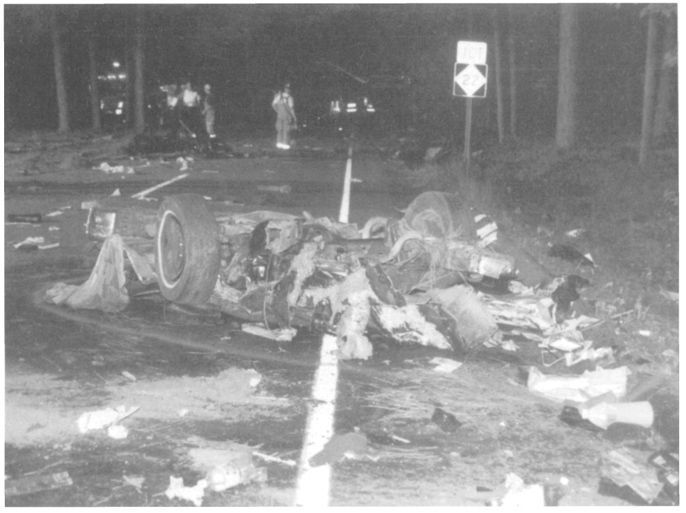
This vehicle split into hundreds of pieces. One dark and rainy night I was traveling on a slick road toward the college in Pinehurst, North Carolina where I teach Holocaust Studies. Riding along with me was Dr. Susan Chernyk-Spatz, an Auschwitcz survivor who was scheduled to speak on her experiences. On the way to the college we passed a horrific crash. I lamented to Susan about how often people are injured and killed in motor vehicle crashes. Her response was that "things are further away in the dark." It took me years to understand what she meant. On December 3-4, 2002, the ninth IEEE Motor Vehicle Event Data Recorder (MVEDR) meeting was conducted at Booz-Allen-Hamilton headquarters in Tyson's Corner, Virginia.1 There were fifty-eight individuals in attendance and several guests including Joan Claybrook of Public Citizen, Professor Michael Edmund O'Neill of George Mason University, and Matthew L. Wald, national correspondent for the New York Times. At the beginning of the meeting there was an announcement that the Peoples Republic of China was interested in joining our project. Mr. Bao Yong Qiang from the Traffic Management Research Institute of the Ministry of Public Security of the People's Republic of China sent a notice that China was working on a vehicle traveling data recorder (VDR). The main function of the Chinese VDR is speed and measurement, distance measurement, monitoring driving activities, displaying, printing, data storage, data downloading and uploading and downloading and uploading protocol. The copyright of this standard belongs to the Standardization Administration of China (SAC). A recent study (2003) conducted by the National Academy of Engineering titled "Personal Cars and China" notes that:
At present, China has relatively few motor vehicles per capita and, of the cars on its highways, few are privately owned. In 2001 China had 18 million vehicles, of which 5 million were cars. If China's number of motor vehicles per capita were comparable to the world average, its fleet would have to total 160 million, with 10 million new and replacement vehicles acquired each year.3 109,363 people died on China's roads in 2002. This fatality figure is more than double the number of people killed on U.S. highways annually. In 2002, traffic crashes accounted for 79% of China's accidental deaths. In the first ten months of 2003, traffic crashes killed 86,000 people and seriously injured an additional 418,000. China's love affair with automobiles is turning dangerous. The explosion in the number of new cars and new drivers is creating havoc on the roads. Besides resorting to tougher rules, new emission standards, and new national traffic laws, the Chinese would greatly benefit from incorporating event data recorder technology in vehicles. At the end of the December 4th meeting, the host from Booz-Allen-Hamilton suggested that two of the three sub working groups be grandfathered. His view was that we were over-reaching. He lost the argument but gained the attention of those that were interested in seeing it happen. NHTSA began receiving comments to Docket NHTSA-2002-13546 on November 19, 2002.4 By October 1, 2003 approximately 82 responses were posted on the USDOT website titled "Docket Management System."5 This chapter provides an overview of the comments received. It does not include all the comments, for to do so would require a much larger book. However, if you want to read the entire docket, it is available through the footnotes and the Docket Management System (DMS) website; you may also refer to the footnotes for more information. It is important to note that I was "selective" in choosing what docket submissions to include, and even "more selective" in the amount of text that I included from each docket. In some cases I chose to submit everything and in others I simply tried to capture the essence of the submission and only included partial text. My objective was to be objective and provide you (the reader) with an overview of the issues. Once again, the footnotes will direct you to the entire submission if you wish for a fuller understanding. |