I could not have generated the information, collected the photographs, or completed the project without the assistance and aid of others. I want to thank all of those who contributed to the successful completion of this book. My first debt is, of course, to my three amazing children who encouraged me to discover my writing purpose and pursue it with intense passion and perseverance. I am grateful that they understood the world must know this story. I am deeply grateful to my friend Mohsin Ali, former diplomatic editor for Reuters, who helped tremendously by serving as a guest lecturer to my college classes while I attended the many meetings. The hundreds of college students who participated in the research and surveys helped to get this book written. Unfortunately, some of these students perished in motor vehicle crashes. Many others were involved in crashes that caused them pain and injury. It was common to hear tragic stories on a daily basis. I constantly thank my college students and remind them that their involvement was important. What is written is never forgotten. I tell them that we learn more from our mistakes than from our successes. Hopefully, in this second century of motor vehicle travel, these students can experience the freedom to travel safely. I received much support and advice, and sometimes the best advice came from the naysayers who told me I was wasting my time. Fortunately, I turned all their negatives into positives. Many individuals are mentioned within, but this book is solely my project and all of the opinions expressed here (except for the direct quotations) are my own. I do not speak or write for the automakers, government safety establishment, standards development organizations, or advocates—but I do include their own works in my book and also what others have commented about them. I do not bash any group for all are important and I am very careful to be factual. I express my grateful appreciation to those who gave permission to use news articles and extended quotations such as the National Academies of Sciences / Transportation Research Board (TRB), the New York Times, Automotive News and EE Times, the World Health Organization (WHO) and the World Bank. Robert Kern, my literary agent in Chapel Hill, North Carolina and Cathy Faduska, my senior editor at IEEE Press / John Wiley & Sons, Inc. and Kay Ethier of Bright Path Solutions, Durham, North Carolina, helped craft the initial structure of my manuscript and greatly improved the book. The entire point of an editor is to decide what is and what is not fit to print, and any book will have some selection criteria. Those criteria and the editor's judgment are its bias. The best that any author can do is make it as clear as possible why everything should be included so as to avoid "unbiased" reporting where no one can be portrayed as being wrong or opposing safety. No courage is required to publish a sanitized, non-critical version of events. To do otherwise requires a higher standard. Vehicle and highway safety cannot be accomplished through the efforts of one person, a group, or a government agency. It is a shared responsibility among people who travel, the companies that provide transport, and the agencies that regulate travel. But, one person can make a difference toward the goal of safe travel. Someday, when we are "actually all safer" while traveling in crash-proof vehicles on intelligent highways, I want to tell my children's children that I knew about this problem and did my best to erase it when I could. I will tell them in life we have two choices, try or do nothing. To me it was impossible to witness the terrible pain and suffering and not get involved. Road safety is no accident. Silence is the ultimate weapon of power in vehicle and highway safety. This book will break that silence. |
 One of the great pleasures of finishing a book is that it gives the author the opportunity to thank those who helped make the project a product.
 TABLE OF CONTENTS
 Chapter 1 - Question Everything
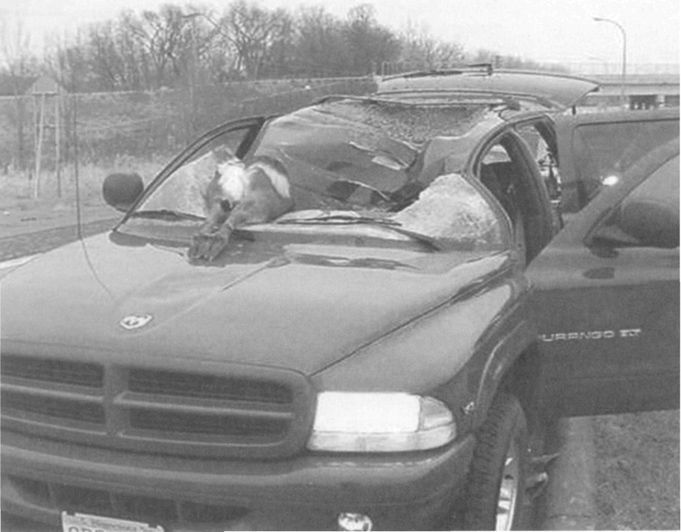 Modern Day Crash - Deer inside vehicle, an incident similar to what my family experienced. My interest in automobile safety isn't driven by personal profit or political gain. It's driven by the simple desire to travel safely. Far too many times in my life, it's been made clear to me just how unsafe our nation's most common mode of transportation really is. As a child, I recall the horrific scene that ensued when, while riding through the rolling hills of northeast Pennsylvania, a deer jumped from an embankment through the windshield of my father's 1956 Hudson automobile. Though the car itself was a tank, the glass shattered like thin ice around the doe, which suffered pitifully and spewed blood all over the car and us until a local game warden put her out of her misery. A few years later, I remember screaming when my father, soaked in blood, returned to our car after pulling to the side of the road to help victims at the scene of a crash he kept hidden from our small eyes. As terrifying as that incident was for me, my father was in fact accustomed to helping victims of car crashes. Our house was situated on a mountain in rural Pennsylvania beside a dangerous road that was the scene of many automobile wrecks. People frequently knocked on our door to use the phone in the middle of the night, waking me and leaving me to wonder what had happened out there on the road. How ironic it was, then, that after having helped so many victims of car crashes, my father himself would perish in one. I never was able to learn the details of his crash, but the gut-wrenching pain of losing him in such a sudden and senseless tragedy is something I'll never forget. Those experiences might have been enough to move me from being merely curious about highway and vehicle safety toward being obsessed, but the incident that actually drove me to begin serious research came years later. It was a muggy June afternoon in 1992, and I was driving a Mazda van through Laurinburg, a small town in eastern North Carolina, heading to the world famous Spoletto Festival in Charleston, South Carolina. Suddenly, an anxious high school student ran a stop sign and crashed his car into the right side of my vehicle. The collision pushed my van into the opposing traffic lane where it was then sideswiped on the left side by a hit-and-run driver in a small truck. Nearly all the windows in my vehicle shattered, and the van was totaled in fewer than ten seconds. The shaved ice of their Sno-Cones chilled the four young children buckled in the back seats of my van, but thankfully, no one was injured in the crash. Any one of us could have been, though. It was, for me, a dramatic realization of how just one false move, one split second in time has the potential to put a family's life into an utter tailspin. The fact that our society accepts the reality of frequent and devastating car crashes without much question is a reflection of just how desensitized and fatalistic we've become. The numbers alone are staggering:
Unless we or someone we love happens to be one of those thousands of people involved in a car crash, we blithely go through our daily routines, driving from place to place without a thought toward what a gamble it is that we take with our lives each time we put the key in the ignition. We don't think about the truly tragic nature of car crashes, usually calling them "accidents" instead. An "accident" is taken to mean an unpreventable tragedy, one where culpability is difficult if not impossible to discern or attribute. We don't ignore the grim reality of what happens when tragedy strikes other modes of transportation: planes crash, trains de-rail, and boats sink. But we insist that motor vehicles are involved in "accidents." Misnaming the event minimizes the true nature of what we're dealing with. An editorial in the June 2001 edition of the British Medical Journal, in which the editors make clear their reasoning for banning the use of the word "accident" from their articles, notes that, "For many years, safety officials and public health authorities have discouraged use of the word 'accident' when it refers to injuries or the events that produce them. An accident is often understood to be unpredictable - a chance occurrence or an 'act of God' - and therefore unavoidable. However, most injuries and their precipitating events are predictable and preventable." Words are powerful, and if the word "accident" continues to convey the sense that we are powerless to do anything to stem the tide of increasing death and destruction on our roadways, then we remain passively resigned to the misconception that there is nothing we can do about it. Nothing could be further from the truth. |