I could not have generated the information, collected the photographs, or completed the project without the assistance and aid of others. I want to thank all of those who contributed to the successful completion of this book. My first debt is, of course, to my three amazing children who encouraged me to discover my writing purpose and pursue it with intense passion and perseverance. I am grateful that they understood the world must know this story. I am deeply grateful to my friend Mohsin Ali, former diplomatic editor for Reuters, who helped tremendously by serving as a guest lecturer to my college classes while I attended the many meetings. The hundreds of college students who participated in the research and surveys helped to get this book written. Unfortunately, some of these students perished in motor vehicle crashes. Many others were involved in crashes that caused them pain and injury. It was common to hear tragic stories on a daily basis. I constantly thank my college students and remind them that their involvement was important. What is written is never forgotten. I tell them that we learn more from our mistakes than from our successes. Hopefully, in this second century of motor vehicle travel, these students can experience the freedom to travel safely. I received much support and advice, and sometimes the best advice came from the naysayers who told me I was wasting my time. Fortunately, I turned all their negatives into positives. Many individuals are mentioned within, but this book is solely my project and all of the opinions expressed here (except for the direct quotations) are my own. I do not speak or write for the automakers, government safety establishment, standards development organizations, or advocates—but I do include their own works in my book and also what others have commented about them. I do not bash any group for all are important and I am very careful to be factual. I express my grateful appreciation to those who gave permission to use news articles and extended quotations such as the National Academies of Sciences / Transportation Research Board (TRB), the New York Times, Automotive News and EE Times, the World Health Organization (WHO) and the World Bank. Robert Kern, my literary agent in Chapel Hill, North Carolina and Cathy Faduska, my senior editor at IEEE Press / John Wiley & Sons, Inc. and Kay Ethier of Bright Path Solutions, Durham, North Carolina, helped craft the initial structure of my manuscript and greatly improved the book. The entire point of an editor is to decide what is and what is not fit to print, and any book will have some selection criteria. Those criteria and the editor's judgment are its bias. The best that any author can do is make it as clear as possible why everything should be included so as to avoid "unbiased" reporting where no one can be portrayed as being wrong or opposing safety. No courage is required to publish a sanitized, non-critical version of events. To do otherwise requires a higher standard. Vehicle and highway safety cannot be accomplished through the efforts of one person, a group, or a government agency. It is a shared responsibility among people who travel, the companies that provide transport, and the agencies that regulate travel. But, one person can make a difference toward the goal of safe travel. Someday, when we are "actually all safer" while traveling in crash-proof vehicles on intelligent highways, I want to tell my children's children that I knew about this problem and did my best to erase it when I could. I will tell them in life we have two choices, try or do nothing. To me it was impossible to witness the terrible pain and suffering and not get involved. Road safety is no accident. Silence is the ultimate weapon of power in vehicle and highway safety. This book will break that silence. |
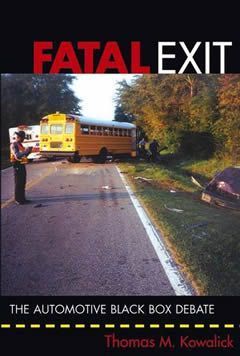 One of the great pleasures of finishing a book is that it gives the author the opportunity to thank those who helped make the project a product.
 TABLE OF CONTENTS
 Fatal Exit - Other Resources
Crash Outcome Data Evaluation System (CODES) (NHTSA): Injuries resulting from motor vehicle crashes remain a major public health problem. These injuries cause an unnecessary burden of increased taxes and insurance premiums. They can be prevented or reduced, but only if we understand what the severity of these crashes are, and their associated health care costs. Crash data alone do not indicate the injury problem in terms of the medical and financial consequences. By linking crash, vehicle, and behavior characteristics to their specific medical and financial outcomes, we can identify prevention factors. CODES evolved from a congressional mandate to report on the benefits of safety belts and motorcycle helmets. NHTSA has funded Alaska, Arizona, Connecticut, Delaware, Georgia, Hawaii, Iowa, Kentucky, Maine, Maryland, Massachusetts, Minnesota, Missouri, Nebraska, Nevada, New Hampshire, New Mexico, New York, North Dakota, Oklahoma, Pennsylvania, Rhode Island, South Carolina, South Dakota, Tennessee, Utah and Wisconsin to link statewide crash and injury data. Probabilistic linkage techniques make it possible for the states to link large state data files in a phenomenally short amount of time at relatively low cost. Crashworthiness Data System (CDS) (NHTSA): NHTSA's Crashworthiness Data System (CDS) has detailed data on a representative, random sample of thousands of minor, serious, and fatal crashes. Field research teams located at Primary Sampling Units (PSUs) across the country study about 5,000 crashes a year involving passenger cars, light trucks, vans, and utility vehicles. Trained crash investigators obtain data from crash sites, studying evidence such as skid marks, fluid spills, broken glass, and bent guardrails. They locate the vehicles involved, photograph them, measure the crash damage, and identify interior locations that were struck by the occupants. These researchers follow up on their on-site investigations by interviewing crash victims and reviewing medical records to determine the nature and severity of injuries. Interviews with people in the crash are conducted with discretion and confidentiality. The research teams are interested only in information that will help them understand the nature and consequences of the crashes. Personal information about individuals - names, addresses, license and registration numbers, and even specific crash locations - are not included in any public NASS files. General Estimates System (GES) (NHTSA): Data for GES come from a nationally representative sample of law enforcement reported motor vehicle crashes of all types, from minor to fatal. The system began operation in 1988, and was created to identify traffic safety problem areas, provide a basis for regulatory and consumer initiatives, and form the basis for cost and benefit analyses of traffic safety initiatives. The information is used to estimate how many motor vehicle crashes of different kinds take place and what happens when they occur. Although various sources suggest that about half the motor vehicle crashes in the country are not reported to law enforcement, the majority of these unreported crashes involve only minor property damage and no significant personal injury. By restricting attention to law enforcement-reported crashes, GES concentrates on those crashes of greatest concern to the highway safety community and the general public. GES data are used in traffic safety analyses by NHTSA as well as other DOT agencies. GES data are also used to answer motor vehicle safety questions from Congress, lawyers, doctors, students, researchers, and the general public. National Center for Statistics and Analysis (NCSA) (NHTSA): NCSA, an office of the National Highway Traffic Safety Administration (NHTSA), an agency in the United States Department of Transportation is responsible for providing a wide range of analytical and statistical support to NHTSA and the highway safety community at large, in the general areas of: Human, vehicle, environmental, and roadway characteristics, as they relate to crash frequency and injuries. National Transportation Library (BTS): The National Transportation Library is a repository of materials from public and private organizations around the country. The Library is intended to facilitate the exchange of information related to transportation. The National Transportation Library is administered by the Bureau of Transportation Statistics in cooperation with the Transportation Administrative Services Center (TASC), the operating administrations and the Office of the Secretary of the U.S. Department of Transportation. TRIS Online, the largest and most comprehensive source of information on published transportation research, is now on the web at http://ntl.bts.gov/tris/. |