Airborne Doppler Radar: Applications, Theory, and Philosophy
An airborne Doppler radar is an airborne radar in which the Doppler effect is used to determine the aircraft velocity. Such a radar also can be used for the navigation and stabilization of an aircraft in flight by sending a sinusoidal wave toward the Earth s surface and using the frequency shift of the reflected wave for navigation and stabilization. For this we ll first review the basic concepts used in an airborne continuous wave (CW) Doppler radar. Then the basic method by which the navigation and the stabilization of an aircraft can be accomplished with the use of a CW Doppler radar will be discussed. The accuracy by which this can be accomplished is determined by the width of the spectrum of the reflected waveform. In order not to obscure the basic theory of how an airborne Doppler radar can be used for navigation and stabilization, we ll defer a discussion of the reflected waveform spectrum until the next chapter.
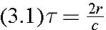
The first uses of radar was for detecting and determining the range of a target. In fact, this application is the source of the acronym radar, which derives from the first letters of the words radio detection and ranging. The target range was determined by measuring the time interval between a transmitted pulse and its echo from the target. The round trip time is
in which r is the distance to the target and c is the velocity of the wave, which is approximately 3 ...