Let f 1( x, y) and f 2( x, y) be two complex valued functions in L 1 so that for a=1 or 2
This condition is sufficient to ensure the convergence of all our integrals. For a = 1 or 2, the two-dimensional Fourier transform pair of these functions is from Eqs. (5.31). [1]
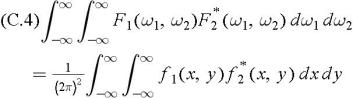
The functions and their transforms then satisfy the Parseval relation
We now note from Eq. (8.8) that
in which g( x, y) is in L 1. Then, with f 1( x, y) = f 2( x, y) = g( x, y) in Eq. (C.4), we have
Further, let
in which both f( x, y) and f x( x, y) are in L 1. Then the Fourier transform of f x( x, y) exists and is
in which F( ? 1, ? 2) is the Fourier transform of f( x, y). Consequently, by letting  in Eq. (C.4), we have
Finally, by letting f 1( x, y) = g( x, y) and f 2( x, y) = ?/ ? x g( x, y) in Eq. (C.4) we have
[1] For Eq.(A.2) and Eq. (A.3) to be a Fourier transform pair, it is just required...
Copyright The American Institute of Aeronautics and Astronautics, Inc. 2006 under license agreement with Books24x7


 TABLE OF CONTENTS