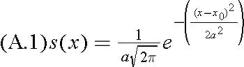
The thin Gaussian antenna pattern given by Eq. (6.69) is
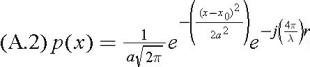
so that from Eq. (6.19), the complex antenna pattern p( x) is
in which  . Then, from Eq. (6.50),
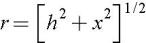
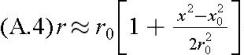
To analytically evaluate this integral, we require a quadratic approximation for the range r about r 0, the radial distance to the beam center on the ground. For this, we have
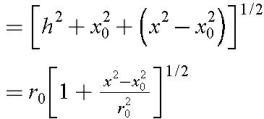
First add and subtract  and then factor out
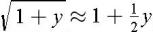
We now use the approximation
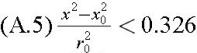
(for which the error is less than 1 percent for y < 0.326) to obtain the approximation
Our approximation thus is
over the range for which s( x) differs significantly from zero. This range is chosen to be x ? x 0 < 3 a. Outside this range, s( x) is less than 1.111 percent of its maximum value so the error obtained by using Eq. (A.4) to evaluate the integral Eq. (A.3) is small.
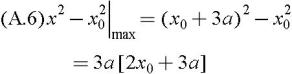
The inequality in Eq. (A.5) can be expressed more meaningfully in terms of the forward-look angle ? 0 and the angular antenna beamwidth ? as shown in Fig. A.1. This is done by noting that the maximum value of  is obtained for x = x 0 + 3 a so that
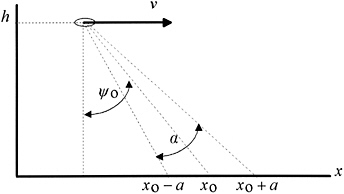 Fig. A.1: Geometry for converting to antenna angular parameters.
 Thus the maximum value of the ratio in Eq. (A.5) is
Now, from Fig. A.1 we obtain the relations
Substituting these relations in...
Copyright The American Institute of Aeronautics and Astronautics, Inc. 2006 under license agreement with Books24x7


 TABLE OF CONTENTS