For the thin Gaussian pattern, we can obtain a better analytic approximation of the effect of the terrain parameter b( x) upon the echo spectrum than was obtained for the narrow antenna pattern obtained in section 6.7B. For our approximation, we consider the case in which there is a linear variation of the parameter b( x) over the central region of the antenna pattern.
The basic equation required is obtained by substituting Eq. (A.18) in Eq. (6.63). For this, we have from Eq. (A.17) and (A.18) that
in which
and
Then
so that, from Eq. (6.63),
and
in which we have defined
Substituting Eq. (B.3) in Eq. (B.7)
in which
which is the same as given by Eq. (A.21). Thus
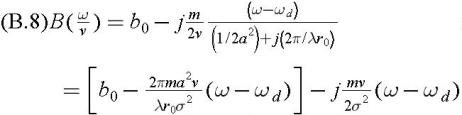
For convenience, we express this equation in the form
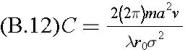
in which
and
We then obtain by substituting Eq. (B.11) in Eq. (B.6) and using Eq. (B.1),
To determine the velocity, a Doppler radar tracks the center frequency of the echo spectrum ? c. This is the frequency below which lies one-half of the total echo spectrum power. The center frequency thus is that frequency ? c for which
To determine ? c for our present case, we substitute Eq. (B.14) in Eq. (B.15) and then let
to obtain
To determine ? from this equation, we express it in a more convenient form by first adding to both sides of this equation the integral from ? ? to ? to obtain
Copyright The American Institute of Aeronautics and Astronautics, Inc. 2006 under license agreement with Books24x7


 TABLE OF CONTENTS