Aircraft and Rotorcraft System Identification: Engineering Methods with Flight-Test Examples
This chapter presents a general overview of the frequency-response method for system identification, which is the focus of this book and is implemented in CIFER . We also present results of the frequency-response method obtained for the XV-15 tilt-rotor aircraft, which, depending on its configuration, has flight dynamics behavior typical of fixed-wing or rotary-wing aircraft. The following topics will be covered in this chapter: 1) basic components of the frequency-response method for aircraft system identification; 2) key features of the frequency-response approach; and 3) overview of the frequency-response method applied to the XV-15, including results for hover and cruise flight configurations.
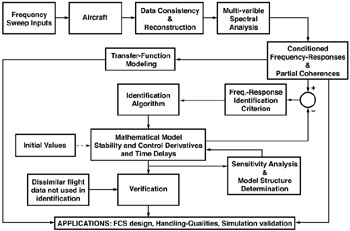
The overall road map for system identification using the frequency-response method, illustrated by the flowchart in Fig. 2.1, is the basis for much of the organization of this book. Each of the elements of the flowchart will be briefly described in this section, with the individual block names referenced in italics within parenthesis.
The frequency-response method for system identification was developed to accurately characterize the dynamic response behavior of fixed-wing aircraft and rotorcraft from flight data. The models are intended for use in a wide range of applications ( Applications), including control system design, handling-qualities analysis, and the determination and validation of simulation math models. The method uses dynamic response time-history test data (e.g., from flight, piloted simulation, bench tests) generated from pilot- or computer-generated inputs, such as sweeps...