Aircraft and Rotorcraft System Identification: Engineering Methods with Flight-Test Examples
Detailed flight-control design efforts are based on very complex high-order and nonlinear simulation models. Force and moment descriptions are developed for each of the aircraft elements, such as the wings or rotors, propulsion system, and flight-control systems, based on wind-tunnel look-up tables, component bench-test data, and analytical theory. The simulation of multiple rigid-body systems or flexible bodies involves sets of dynamic equations of motion linked by constraint conditions. In many simulations these sets of equations are numerically integrated in serial form to reduce the complexity of deriving a fully coupled multibody simulation. The distributed or serial nature of these complex simulations thus might preclude the extraction of an integrated high-order linear model of the fully coupled system that is needed for accurate control design studies. Also, when the simulation models include control system nonlinear elements such as deadzone, hysteresis, saturation, and even Boolean logic, the numerical perturbation methods will often give the wrong result.
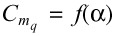
Even when the simulation architecture allows for the direct extraction of higher-order linear models using classical numerical perturbation methods, the assumption of independent perturbation results in incorrect phasing of the state variables within the multidimensional look-up tables. For example, the look-up table for aerodynamic pitching moment might depend both on angle of attack and pitch rate, so that
. Thus the correct determination of phugoid dynamics depends on maintaining representative phasing of q and ? within the linearization process. Selection...