Aircraft and Rotorcraft System Identification: Engineering Methods with Flight-Test Examples
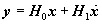
The equations of motion from Sec. 13.3 are now cast in the state-space form
| (13.25) | |
| (13.26) | |
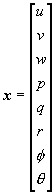
The six-DOF equations of motion are composed of eight states, describing the motion of the fuselage center of gravity and the rotation of the body,
| (13.27) | |
and four bare-airframe controls. (Here we have dropped heading angle ? because it does not influence the dynamic response of the aircraft.) For fixed-wing aircraft, the control vector consists of the inputs for roll, pitch, yaw, and throttle:
| (13.28) | |
In the case of rotorcraft applications, the control vector consists of the inputs for roll, pitch, yaw, and heave:
| (13.29) | |
With the state and input vectors defined, it is a relatively simple matter to cast the equations of motion (13.12 13.14), (13.17 13.19), (13.22), and (13.23) in the form of Eqs. (13.25) and (13.26) and define the structure of the M, F, and G matrices. The components of the F matrix reflect the force and moment gradients to state perturbations from trim and thus are stability derivatives (e.g., X u, X w, M w, M q). The components of the G matrix reflect the gradients to control perturbations from trim and thus are the control derivatives (e.g.,
).
The components of M include parameters that depend on the rates of change of the state variables. In the case...