Best Practice in Inventory Management, Second Edition
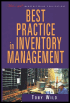
Use this reference to learn to implement a variety of processes vital to inventory structure and control.
 TABLE OF CONTENTS
 The use of Pareto analysis to save time and give control
ABC for managing inventory
Stock cover provides a monitoring tool
Minimizing effort and inventory value
A guide to reducing inventory levels
In the stores there are a wide variety of items, with a stock record for each. Some have high value and others are very cheap. The high-value items are normally controlled tightly, whereas the low-value items are not treated as carefully and are issued in bulk in approximate quantities. Most effort should be put into managing the items which are most important for achieving the inventory targets. In inventory control the best results are gained by organizing effort correctly. There is not sufficient management time to maintain detailed control of all the individual items. If the immediate aim is to reduce stockholding costs then studying the stock of low-value items is unlikely to be the best place to start unless the sales volume is very large. If service is the aim, then attention to a few fast-moving lines often provides the bulk of the improvement required.
This simple principle is embodied in Pareto's Law, which is illustrated by the curve in Figure 3.1. It is also called the 80/20 rule because 80 per cent of the effect is provided by 20 per cent of the cause. In Figure 3.1 80 per cent of stock value is caused by 20 per cent of stock lines. The principle can be applied...