Best Practice in Inventory Management, Second Edition
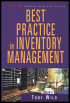
Use this reference to learn to implement a variety of processes vital to inventory structure and control.
 TABLE OF CONTENTS
 Order patterns with safety stock
Successful calculation of review level
When to expedite
The effect of supply lead times
Co-ordinating supply with target stock levels
Our aim in stock control is to maintain a balanced inventory so that customer service for each stock item is maintained within its proper limits. The time at which we can influence the stock levels most effectively is when we order, and it is at this point that the major opportunity occurs for ensuring a balanced inventory. This is the major control mechanism for ensuring a balanced inventory. It is also the point at which customer satisfaction or excess inventories are created. The technique for calculating the right time to order inventory is crucial to balancing these conflicting pressures.
Originally stock-recording systems used to include stock control levels as 'minimum' and 'maximum' stock levels. These basic concepts are still applied today as a simplistic approach where tight control over stock is not necessary. The use of a minimum stock level for order control is not sensible, since the minimum occurs immediately before delivery. Items have to be ordered well in advance of this, so control is through a 'reorder level' not a minimum stock. However, a minimum stock level is vital for ensuring that there is warning of low stocks. In a stock control system, therefore, there is a need for both reorder level and minimum stock level. These are called the 'review level' and 'safety...