Composite Materials for Aircraft Structures, Second Edition

A fiber composite material consists of a filamentary phase embedded in a continuous matrix phase. The aspect ratio (i.e., ratio of length to diameter) of the filaments may vary from about 10 to infinity (for continuous fibers). Their scale, in relation to the bulk material, may range from microscopic (e.g., 8- ?m diameter carbon fibers in an epoxy matrix) to gross macroscopic (e.g., 25-mm diameter steel bars in concrete).
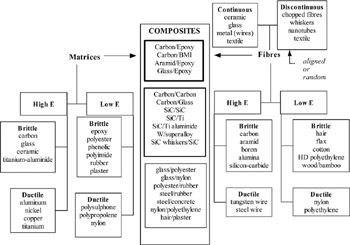
Composite constituents (fibers and matrices) can be conveniently classified according to their elastic moduli E and ductility. Within the composite, the fibers may, in general, be in the form of continuous fibers, discontinuous fibers, or whiskers (very fine single crystals with lengths of the order 100-1000 ?m and diameters of the order 1-10 ?m) and may be aligned to varying degrees or randomly orientated. This classification is depicted in Figure 2.1 for a number of common fibers and matrices; also listed are examples of composites formed from these materials.
Fiber composites can be studied from two points of view: micromechanics and macromechanics. Micromechanical analyses are aimed at providing an understanding of the behavior of composites, usually those with unidirectional fiber reinforcement, in terms of the properties of the fibers and matrices. Models of varying degrees of sophistication are used to simulate the microstructure of the composite and hence predict its properties (such as...