Composite Materials for Aircraft Structures, Second Edition

Piezoelectric materials have the ability to generate charge when subjected to mechanical stress, and conversely can elongate or contract when subjected to an electrical field. [1] Typical piezoelectric materials are: quartz, barium titanate, cadmium sulphide, lead zirconium titanate (PZT) and piezoelectric polymers polyvinyldene fluoride (PVDF), polymer films, and polyvinyl chloride (PVC).
Piezoelectric ceramic materials such as lead zirconate titanate [Pb(ZrTi)O 3], known as PZT, exhibit the piezoelectric effect where the size of the deformation or voltage depends on crystal orientation. Properties of PZT are stable in the range ?22 C to = 155 C. PZT can be manufactured in thin plates, strips, or fibers suitable for embedding or surface bonding.
Piezoelectric properties are established by applying at elevated temperature a high electrical field in a direction known as the polling direction to align all the ferroelectric domains within the ceramic (i.e., to achieve constant polarization direction). Conventional PZT wafers or plates are generally polarized normal to the plane of the sheet. When a voltage is applied to the conducting layers on the surface of the sheet, the sheet deforms or develops in-plane forces.
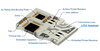
Conventional PZT sheets are quite brittle (low strain to failure), limiting in actuation capability, and are intrusive if embedded in composite laminates. A new concept for the actuation and sensing of structures using PZT fibers and interdigitated electrodes has been developed (Fig. A.1). This material incorporates unidirectional PZT fibers (typically about 130 ?m in diameter) into a matrix, producing a...