Composite Materials for Aircraft Structures, Second Edition

| Symbols | |||
| Shear modulus (also used for strain energy release rate) | G | Young's modulus | E |
| Shear stress | ? | Stress | ? |
| Shear strain | ? | strain | ? |
| Thickness | t | Displacement | U |
| Transfer length | L | ||
| Plastic zone size | d | Applied load | P |
| Step length | N | Transmitted load | T |
| Scarf angle | ? | Thermal expansion coefficient | ? |
| Temperature range | ? T | ||
| ? T = (service temperature-cure temperature) | |||
| Subscripts/Superscripts | |||
| Plastic condition | P | Outer adherend (also for mode 1 opening) | 1 |
| Elastic condition | e | Inner adherend (also for mode 2 opening) | 2 |
| Ultimate value | u | Maximum value | max |
| Adhesive | A | Minimum value | min |
| Temperature | T | balanced | b |
| Value at infinite length | ? | Unbalanced | un |
| Critical value | C |
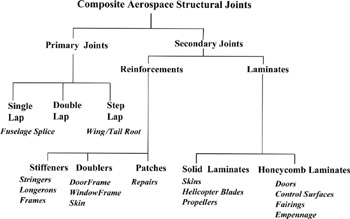
Bonded joints used in aerospace applications can be classified as single (primary) or multiple (secondary) load path joints, as indicated in Figure 9.1. This section describes simple design procedures and some materials' engineering aspects relevant to the application of these types of joint in airframe structures.
In the design of bonded composite joints, consideration is given to each of the elements to be joined (adherends), including their geometry, size, materials of construction, actual or potential modes of failure, coefficients of thermal expansion, magnitude and nature of the loading involved, and operating environment.
Potential modes of failure are:
Tensile, compressive, or shear of the adherends
Shear or peel in the adhesive layer
Shear or peel in...