Composite Materials for Aircraft Structures, Second Edition

As a result of their strong directional interatomic bonds, elements of low atomic number, including C, B, Al, and Si, can be formed into stiff, low-density materials. These materials may be made entirely from the elements themselves (e.g., C or B), or from their compounds (e.g., SiC), or with oxygen or nitrogen, (e.g., Al 2O 3, SiO 2 or Si 3N 4).
The strong bonding [1] also inhibits plastic flow, at least at temperatures below around half the melting temperature. Because these materials are unable to relieve stress concentrations by plastic flow, they are markedly weakened by sub-microscopic flaws, particularly those open to the surface. Thus, it is generally only when made in the form of fibers that the inherent very high strength of these materials can be realized. [2], [3] There are several reasons for this, including the following:
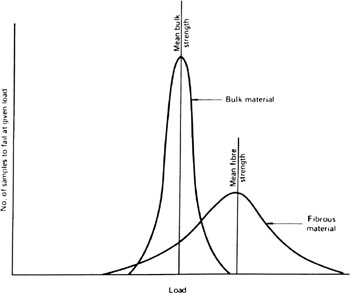
The probability of a flaw being present (per unit length) in a sample is an inverse function of volume of the material, as described by Weibull statistics. [4] Hence a fiber having a very low volume (per unit length) is much stronger on average than the bulk material. However, the bulk material, having a much higher content of weakening flaws, exhibits a much lower variability in strength, as shown in Figure 3.1. It follows similarly that the smaller the fiber diameter and the shorter the length, the higher the average and maximum strength, but the greater the variability.
Figure...