Digital Asset Management: How to Realise the Value of Video and Image Libraries

Media management is a term that different people understand according to the context. This partly stems from the word 'media'. The word even has several meanings within the concept of asset management. As the plural of medium, it can refer to the way something is communicated as in the medium of sound or the medium of television. From this we have the 'mass media' meaning newspapers, magazines, radio, and television. Another meaning is as a substrate for content, as in tape media. This usage has its roots in such use as the artist's medium; the water or oil that carry the pigments are used for painting. Exploiting these many uses, the American television comedian, Ernie Kovacs, once said: 'Television: a medium. So called because it is neither rare nor well done'.
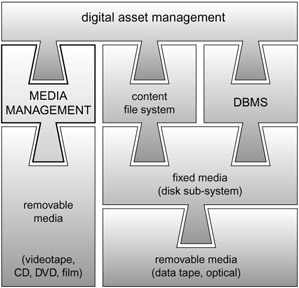
It is a truism that the media store their content on media. Media management is about the latter, the physical medium that stores the content assets. In the case of video, this means videotape, but it includes film, data tape, CD-ROMs, and the DVD. Media management underlies the digital asset management in much the same way as the database management system (DBMS) that used to store persistent data for the control of the content (Figure 3.1).
Media management is not limited to digital assets. Much of the media may be from analogue archives, like movie film, photographs, or paper documents.
Much of this chapter describes the development of media management...