Digital Asset Management: How to Realise the Value of Video and Image Libraries

In this chapter, I am going to take a document to mean a file containing written information, possibly with embedded graphics. In the chapter on document management, I laid out the formal definition as 'a written or printed record that provided proof of identification, an agreement or ownership'. Typically, it could be a contract drawn up by a lawyer, or an identity card issued by a government. The original Latin meaning of proof became lost with the introduction of the computer. The term 'document' was applied to any writing that conveyed information. It could be a text file or a spreadsheet, a slide presentation or a CAD drawing. To the lawyer, a document is a specific proof or evidence, whereas to the average business a document is synonymous with a computer file. The file extension for a Word file, . DOC, reinforces this association.
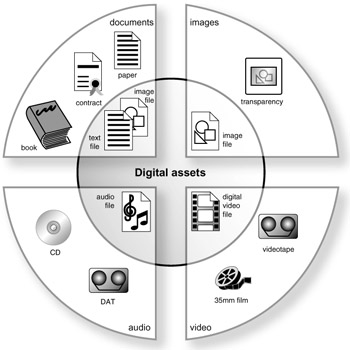
A document file is a subset of a computer file (Figure 5.1). We would not think of a Photoshop file as a document, nor a database. A document is unstructured written information, although the CAD file blurs the distinction between the written and the drawn. Before the age of the computer, the document was any form of office paperwork, written, drawn, or typed.
In the context of digital asset management documents are files, so physical documents must be scanned into a digital format. The document can either be stored as an image, or via optical character recognition, stored...