Digital Asset Management: How to Realise the Value of Video and Image Libraries

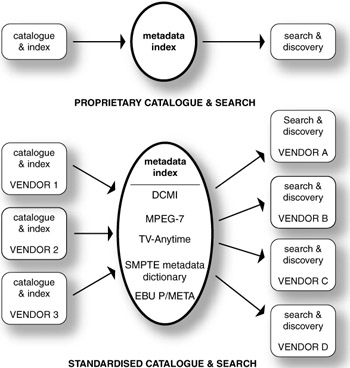
Previous chapters have described how content can be indexed, categorised, and searched. Not unnaturally, there have been many proposals to standardise the way that content is described in the index database. Such a move will ease the interoperability between applications.
The complexity of audio-visual content, and the wide range of applications, have led to several frameworks emerging, each focused on one area of use. The moving picture experts group (MPEG) has developed a content description standard for audio-visual content. Another group, called the Dublin Core Metadata Initiative (DCMI), have developed a metadata standard for web resource discovery. These are very general proposals that can be applied to a wide range of content types in many different industries.
There are also industry specific standards. The TV-Anytime Forum has published several specifications for use with television set-top storage devices (the personal video recorder or PVR). For television production, the Society of Motion Picture and Television Engineers (SMPTE) have developed an extensive metadata dictionary, and the European Broadcasting Union (EBU) has been looking at the requirements for metadata to enable programme interchange and archive (Figure 10.1):
MPEG-7 content description for audio-visual material; ISO/IEC: 15938
'DCMI'. Internet Engineering Task Force (IETF): RFC 2413
TV-Anytime
SMPTE metadata dictionary
EBU P/META
International Press Telecommunications Council (IPTC) for the news industry
Exchangeable image file format (EXIF) for still photographs.
MPEG is a working group of ISO/IEC in charge of the development of international standards for compression, decompression,...