Networking Explained, Second Edition

An in-depth explanation of all things networking.
 TABLE OF CONTENTS
 Although you have mentioned Internet addresses before, you really haven't discussed them in any detail. Can you do this now, please?
Yes. In fact, this is a good place to do it. Internet addresses (called IP addresses for short) are node addresses that identify their location within the Internet. IP addresses play an important role in the successful delivery of data across the Internet. If a node cannot be located, then data cannot be delivered to it. Currently, two versions of IP addresses are available: Version 4 (IPv4) and version 6 (IPv6).
Please describe IPv4 addresses.
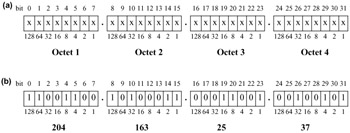
Okay. IP Version 4 addresses (IPv4) consist of 32 bits (0 through 31) partitioned into four groups of eight bits each (called octets). Since it is difficult for us to read addresses in binary notation, IP addresses are expressed in decimal form; a decimal point (read as "dot") separates the octets. An example of an Internet address is 204.163.25.37. Each octet of an IP address is treated as an independent unit. Since octets comprise eight bits, the contents of each octet can contain anywhere from eight 0-bits to eight 1-bits. The decimal equivalent of an all 0-bit octet is 0, and the decimal equivalent of an all 1-bit octet is (2 8 - 1) = 255. This is illustrated in Figure 3.18(a) with the letter x being used in a general manner to represent bits. The bit pattern for the IP address 204.163.25.37 is shown in Figure 3.18(b).