Networking Explained, Second Edition

An in-depth explanation of all things networking.
 TABLE OF CONTENTS
 In Chapter 4, we focused mostly on network media and the physical layer (layer 1 of the OSI model) but did not discuss any specific layer 1 components. Similarly, in Chapter 5, we examined the data link layer (layer 2 of the OSI model) but did not provide any information about layer 2 devices. In this chapter we make up for these intentional omissions by presenting various layer 1 and layer 2 devices, including connectors, transceivers and media converters, repeaters, network interface cards and PC cards, bridges, and switches. An outline of the devices we discuss follows:
Connectors (Questions 1 6)
Transceivers (Questions 7 12)
Repeaters (Questions 13 19)
Media Converters (Question 20)
Network Interface and PC Cards (Questions 21 38)
Bridges (Questions 34 45)
Switches (Questions 46 57)
What are connectors?
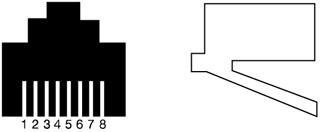
Connectors attach components together. Several types of connectors are available, serving various purposes. For example, connectors are used to: (a) connect network interface cards, such as an Ethernet card, to a cable; (b) connect cable segments (e.g., thin coax to thin coax); and (c) terminate a segment. In this last category, connectors actually connect the cable to a terminating resistor or an array of resistors and are consequently known as terminators. The type of connector used is usually a function of cable type. For example, eight-pin modular connectors are used with UTP cable (Figure 6.1). Connectors are also classified by their gender.