Networking Explained, Second Edition

An in-depth explanation of all things networking.
 TABLE OF CONTENTS
 In this chapter we present information about a network technology called fiber distributed data interface (FDDI). FDDI employs a ring topology with fiber-optic cabling as its physical layer medium. We also discuss a "sister" standard called copper distributed data interface (CDDI), which uses copper instead of fiber. An outline of the terms and concepts we define and discuss follows:
General Information (Questions 1 6)
Physical Layer Issues (Questions 7 10)
Data Link Layer Issues (Questions 11 13)
Operation and Configuration Issues (Questions 14 22)
FDDI and Ethernet/802.3 (Questions 23 24)
FDDI and ATM (Question 25)
CDDI (Questions 26 through 28)
Future of FDDI (Question 29)
What is FDDI?
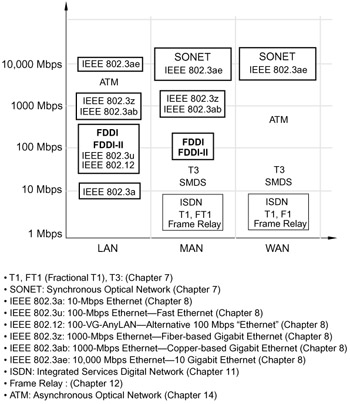
FDDI stands for fiber distributed data interface. FDDI networks are described by ANSI standard X3T9.5 created in 1986 for interconnecting computer systems and network devices typically via a fiber ring topology at 100 Mbps. Figure 10.1 shows where FDDI networks fit in the hierarchy of network architectures. (For information about the other network architectures listed in this figure, see the appropriately named chapters.)
In what capacity are FDDI networks used?
FDDI's bandwidth gives it considerable flexibility in how an organization allocates its resources. Its applications include directly connecting workstations and servers in work-groups, and serving as a high-speed backbone to connect other networks in a building, in a campus environment, or in a city. An example of the first application is the interconnection of high-speed servers to other high-speed servers. For...